

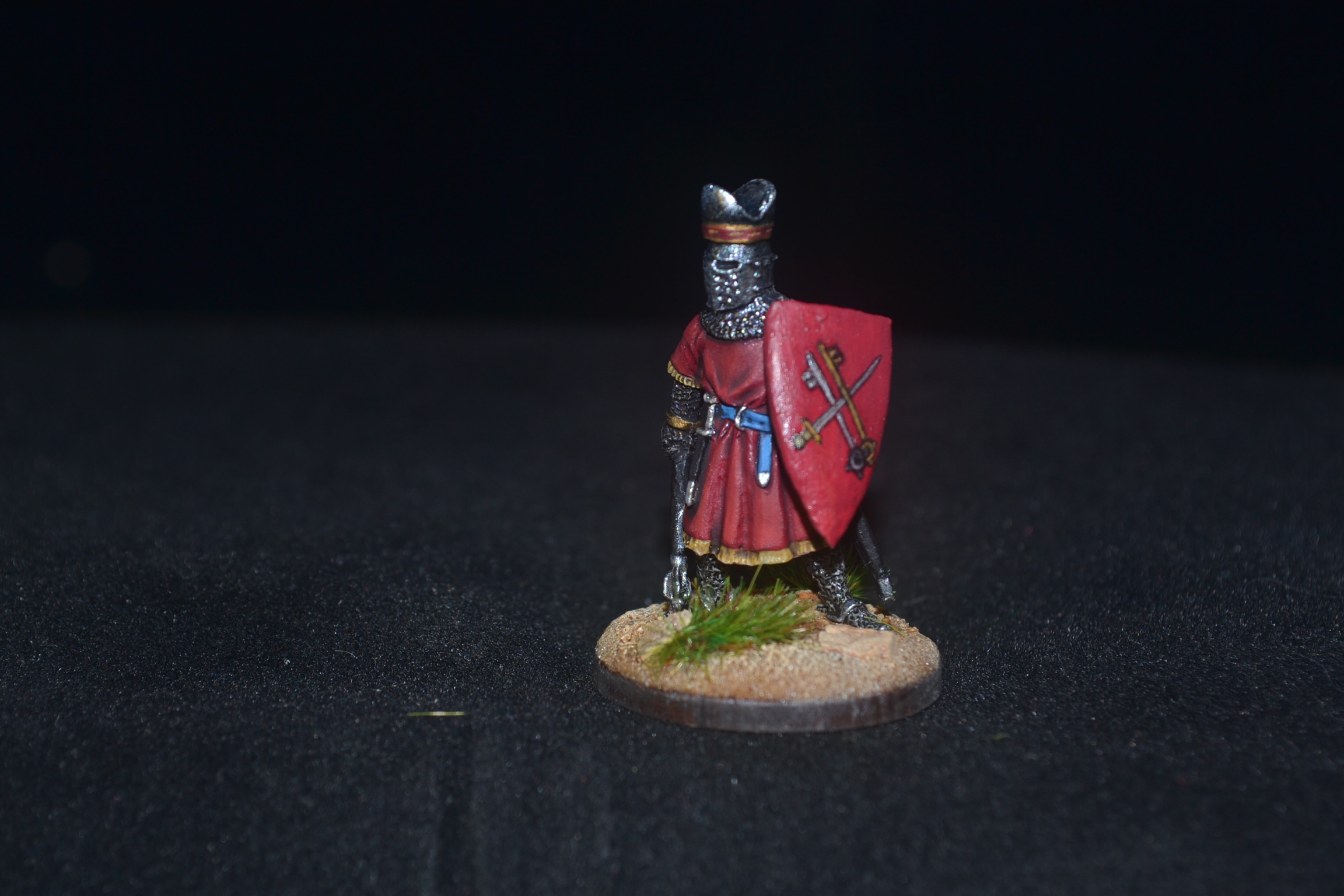
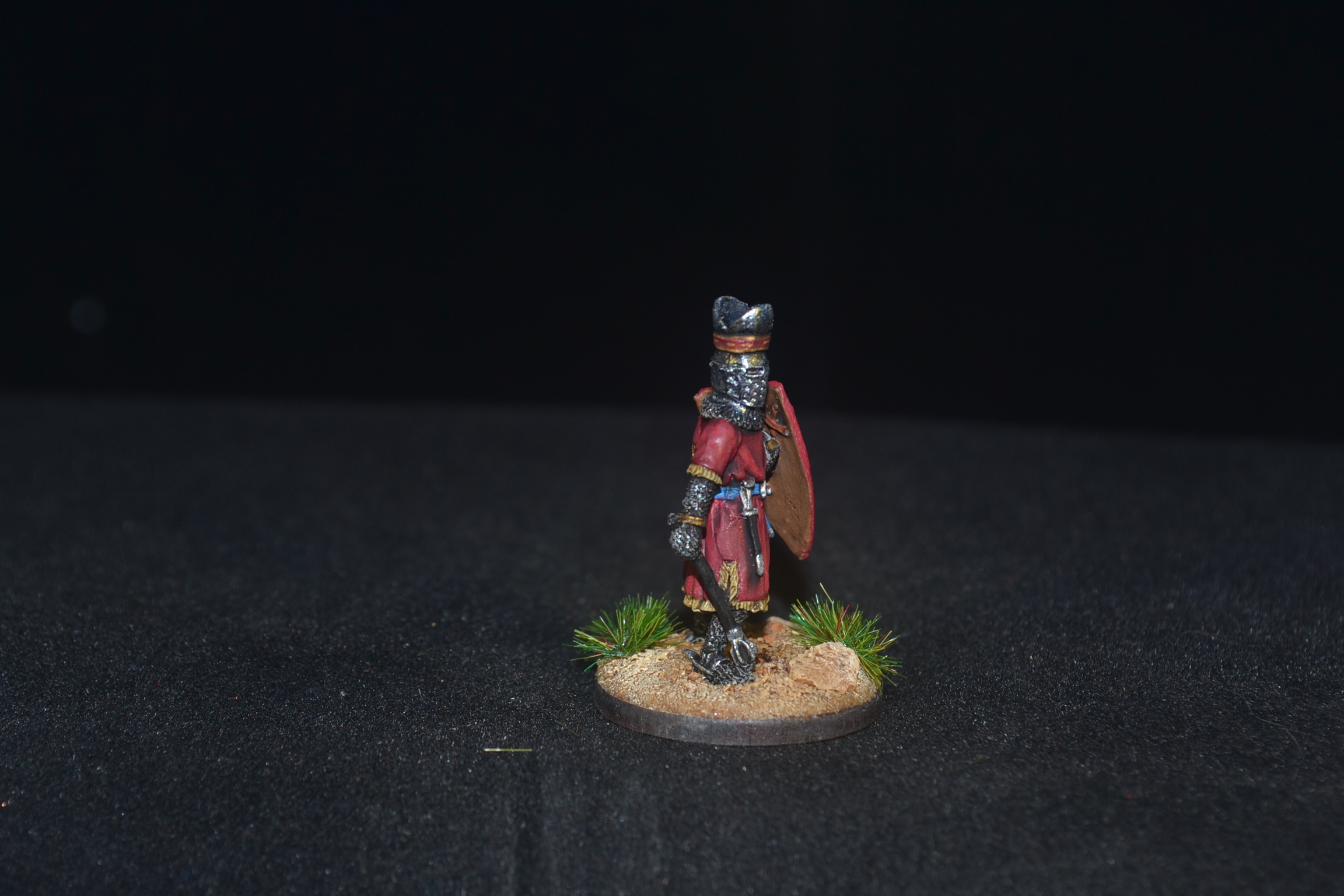
This weeks Footsore Baron’s War figure is a nice little sculpt of Peter Des Roches, Bishop of Winchester. Now I’m not going to pretend I know anything about this particular little chap and what little I have learnt thus far is confined to Wikipedia which I have copied and posted below. Clearly he was a significant personality of his age.
As far as the painting goes for this figure I elected to go with a scheme similar if not identical to that shown on the Footsore website. I assume it to be a pretty accurate depiction but even if it isn’t I quite liked the look anyway. A mostly straight forward paint job but the shield did offer a freehand challenge. The heraldry for the Bishop is shown as two keys and a crossed sword.
Hard to know just how pious the clergy were back in these days. I presume the mace he is carrying wasn’t just for show and that he was an accomplished fighter. Makes me wonder what people would make of today’s clergy if they took to the pulpit wielding AK47’s or something similar? I reckon it it would make for an interesting sermon. It would certainly grab my attention!
Wikipedia narrative below followed by images of Peter des Roches.
TIM
—000—
WIKIPEDIA
Towards the end of Richard I‘s reign, Peter became Lord Chamberlain and an influential counsellor. He held the ecclesiastical offices of Archdeacon of Poitiers, treasurer of Poitiers, and was a precentor of the diocese of Lincoln in 1204.[2]
In early 1205, through John’s influence, Peter was elected to the see of Winchester.[3] His election was disputed but, on appeal, confirmed on 25 September 1205 by Pope Innocent III.[4] Peter was consecrated on 24 March 1206.[3] Nonetheless, the new bishop stood by John’s side during the whole period of the papal interdict set upon him due to John’s refusal to accept Stephen Langton as Archbishop of Canterbury despite Papal warning.[citation needed]
In 1213 Peter was made Chief Justiciar in succession to Geoffrey Fitz Peter.[5] This promotion was justified by the fidelity with which Peter supported the king through the First Barons’ War. However, by 1215, Hubert de Burgh was Chief Justiciar.[5] In 1216, Peter was named Sheriff of Hampshire.[6]
At the battle of Lincoln in 1217 Peter led a division of the royal army and earned some distinction by his valour; but he played a secondary part in the government so long as William Marshal held the regency. After Marshal’s death in 1219 Peter led the baronial opposition to Hubert de Burgh, with varying success. At first the justiciar was successful.
Peter was responsible for founding several monasteries in England and France,[7] including Titchfield Abbey[8] and Netley Abbey,[7] both in Hampshire, England, and La Clarté-Dieu[7] in Poitou, France. He gave his protection to the first group of Dominican friars to come to England in 1221.[9]
In 1225 a plot to ship Eleanor of Brittany, who as cousin to Henry III always posed a potential threat to the crown and was thus viewed as a state prisoner and then confined at Bristol Castle, away to France, was reported. The plot might have been false and only fabricated to discredit Peter, and he eventually fell out of royal favor in spring 1234.[10]
Crusading bishopEdit
Peter participated in the Sixth Crusade alongside William Briwere, who was Bishop of Exeter.[11] An army of other crusaders accompanied them to the East, although whether they were English or mercenaries recruited on the Continent is unclear. The contingent left from Brindisi in August 1227.[12] Both bishops were influential advisors to Frederick II the Holy Roman Emperor[11] even though Pope Gregory IX had ordered that no one collaborate with Frederick, who was at the time excommunicated. Both bishops ignored the papal orders and worked closely with Frederick’s agents and Frederick himself. The financial resources both bishops brought were especially appreciated by the crusaders.[11] Both bishops witnessed the treaty on 18 February 1229 with the Sultan of Cairo that restored Jerusalem to the Christians,[11] the Treaty of Jaffa.[12] After the crusade, he spent time in Italy.[6]
Peter died on 9 June 1238.[3]
—000—


 The Imperfect Modeller
This collection is state of the art! So impressed( and a little jealous!!!)
Best
Mike
LikeLike
Cheers Mike. I’m not sure if they will ever find themselves on a gaming table but I am trying to make them all the best I can. 🙂
LikeLiked by 2 people
Well that would be a crying shame!!!
I’m such a fan of those knights! I did consider some kinds of sabots but there are so many amazing minis I thought get ones for mass battle and saga skirmish!!!!! It will have to be transfers for me though!!!
LikeLiked by 2 people
Well they might not see a game Mike but I’m hoping to take them to a few shows as and when it’s possible to do that again. Nothing wrong with decals either so go for it!
LikeLike
That’s lovely mate – the heraldry is just fantastic!
LikeLiked by 3 people
Cheers Alex. I never thought I’d find myself painting keys I have to say! 🙂
LikeLiked by 2 people
Excellent work on the bishop TIM, the freehand looks perfect. Interesting bit of history you found on him as well.
LikeLiked by 3 people
Thanks Dave. I’m never to sure what characters are actually real and I don’t Google details for them all but this guy seemed to have an interesting life!
LikeLiked by 2 people
Very nice, the free hand on the shield is great, very precise.
LikeLiked by 3 people
Thank you. I’m continuing to practice the freehand and some work out better than others but it’s all fun and that’s what matters. 🙂
LikeLiked by 1 person
Your free hand work is becoming legendary mate!! absolute top work!
Cheers Roger.
LikeLiked by 3 people
Haha, not sure about being a legendary Roger but I am loving doing freehand. I like the idea of something personal and unique which I’m guessing is part of the appeal for you with your sculpts?
LikeLike
Nah I’m just to tight to buy figures!! 😁
Cheers Roger.
LikeLiked by 2 people
The heraldry is absolutely superb, and the red is really well done. The blue and yellow add the perfect touch.
LikeLiked by 4 people
Thanks Matt. I am enjoying the freehand and the heraldry but some of it out there looks very scary!
LikeLike
Very nicely done, Dave! 🙂
LikeLiked by 3 people
Thanks John. 🙂
LikeLiked by 1 person
Very nice- love the shield.
Cheers,
Pete.
LikeLiked by 3 people
Thanks Pete. 🙂
LikeLiked by 1 person
Great work on a magnificent sculpt. I really like the helmet on this one. It would be pretty imposing on the battlefield I would think. The shield looks really great as well as per usual 🙂
LikeLiked by 3 people
Thank you. At the risk of getting boring the figures across the range are excellent and this one is no exception. 🙂
LikeLiked by 1 person
The figure as always is painted to your amazing standard, but I have to add your skill with the heraldry is coming ahead with leaps and bounds, next you’ll be painting the Henry Plantagenet, and his Royal Arms.
LikeLiked by 3 people
Haha, not sure about that but I am trying to make incremental steps and try new things. Some work better than others but practice and perseverance, not to forget swearing, usually produce an end result for better or worse. 🙂
LikeLiked by 3 people
Like Kuribo said the helmet is unusual , and again great work on the shield, top marks again mate!
LikeLiked by 4 people
Thanks Pat. 🙂
LikeLiked by 2 people