Messing About with Realistic Water … Again! (Part 2)

Progress on my canoe diorama continues albeit slower than I’d like.  As a modeller I have a reasonably high degree of patience but the time it takes for this stuff to dry is testing.  As a consequence I am able to share some more progress images but the final model is still a little way off.  Hopefully by this time next week I’ll be there.

Not much to report on the ground work side of things.  The tree and river bed foundations follow tried and tested methods and have been covered in previous posts so I wont bore people by repeating myself.

Although the pictures below don’t show it the tree is now complete and the canoe and figures have been painted.  The problem is that the diorama is on a slope and taking photos are a little tricky while I’m still waiting for the water to set.

While I’ve been waiting for the Realistic Water to dry so I can work with it more I decided to paint a 28mm Greek hoplite.  Not really my historical period of interest but thought I’d have a go at something different for a change.  The figure is from 1st Corps and a very impressive casting it was too.  They have a good range but deal more with Ancients.  I have yet to decide whether or not to paint a few more of these chaps or not and even if I do not entirely sure how to present them.  No doubt I’ll think of something.  Not entirely happy with the completed figure.

20170805_11043020170805_20584620170806_112442

20170807_162803.jpg

Watching Realistic Water dry is boring to say the least.  Next time I will have to see what other products are out there.  In the meanwhile a Greek hoplite which has no baring on this diorama whatsoever!!

TIM

20170909_110212_resized20170909_110301_resized20170909_110229_resized


Messing About With Realistic Water … Again!

In my last post I mentioned that I had plans to do a model using a canoe as the basis of the small diorama I had in mind.  Well the figures arrived earlier in the week and work is underway.  A few companies do 28mm scale canoes with figures but I settled on buying one from “Black Powder” care of http://www.warlordgames.com.  They do a few different figure options but I decided to go with the Frontiersmen as per the image below.

WG7-FIW-45-Frontiersmen-in-Canoe-b

The figures are white metal, the canoe plastic.  I had planned to do some selective amputation to the arms to change the poses slightly but the figures appear to be a bit smaller than 28mm (nearer to 25mm).  As even basic sculpting is not an area of strength I have decided to leave them alone and simply position them in the canoe as best I can.

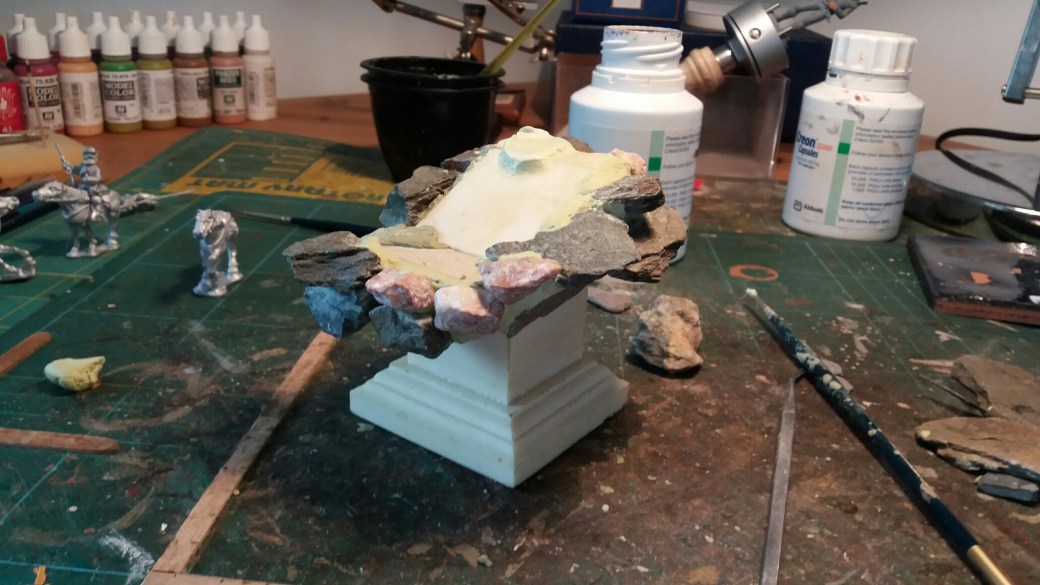
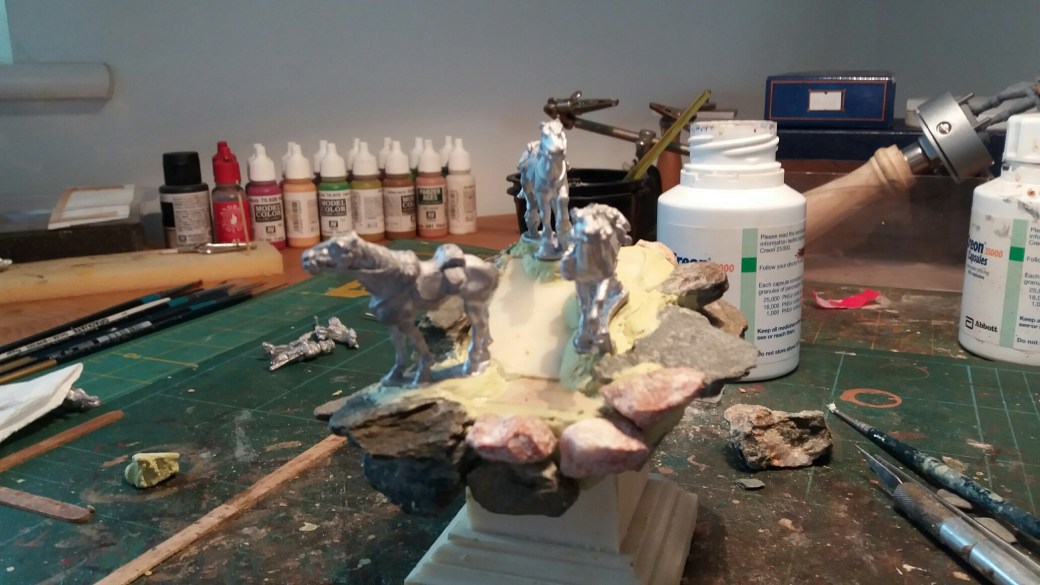
Base work is under construction using some tried and tested methods and a few pictures of current progress appear below.  Key to my design is the sloping base which I bought cheaply online (I really must start looking at making more of my own bases).  The idea I have in mind is for the canoe and its occupants to be riding the rapids.  Getting my head around how to add realistic water to a slope is the next challenge but I have a few ideas to trial so we will see how that works out.

20170803_18134920170804_10070220170805_110430

Certainly doesn’t look great but am feeling confident that it will all come together!!!

In the meanwhile a few additional photo’s relating to my previous post as requested by IRO!

TIM

20141214_13524220141203_07303220141214_13530820141214_135210


Messing About With Realistic Water

Fully recharged after an excellent holiday and with a potential modelling ideas list as long as my arm I’ve decided that my next project will be a small diorama with flowing water being a main feature. The basic idea came from seeing some people out canoeing while away on holiday. Not entirely sure why I’ve settled on this idea from countless others but identifying the models to buy quickly certainly had a bearing. It will give me the time to source the things I need for other ideas while keeping my hand in.

The models needed are on order and should arrive shortly but in the meanwhile I thought I would share some details on the first water themed diorama that I put together a little while ago and before I started this blog. As with most first attempts a lot was learnt but overall I was reasonably pleased with the end result.

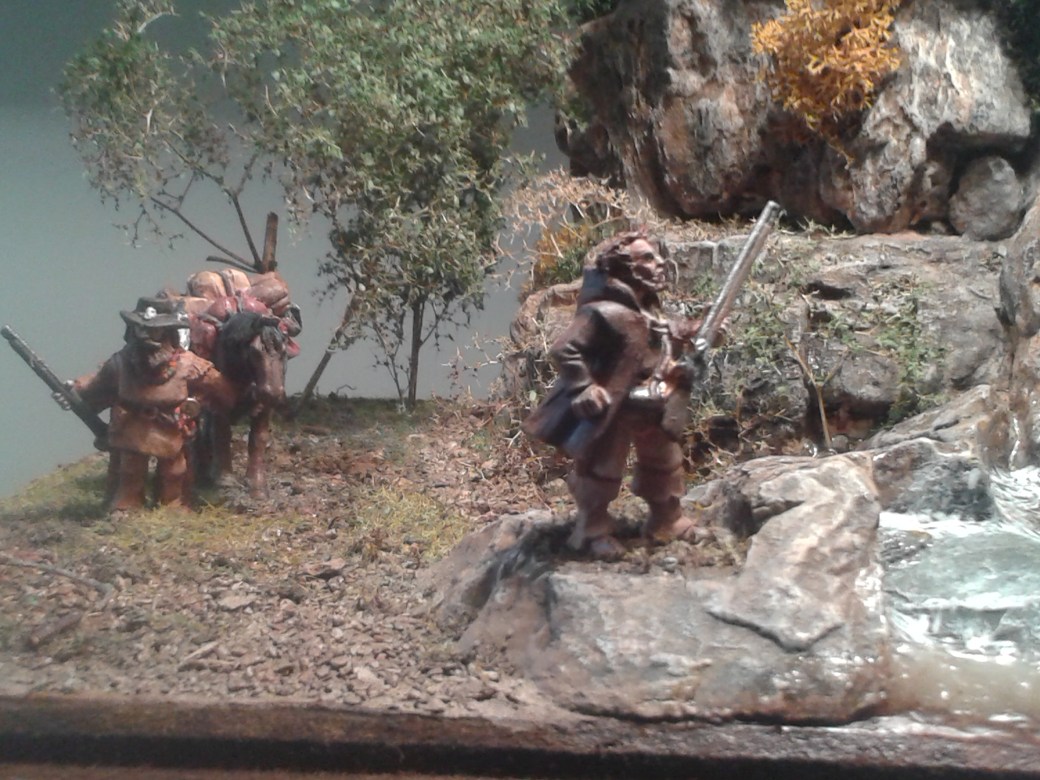
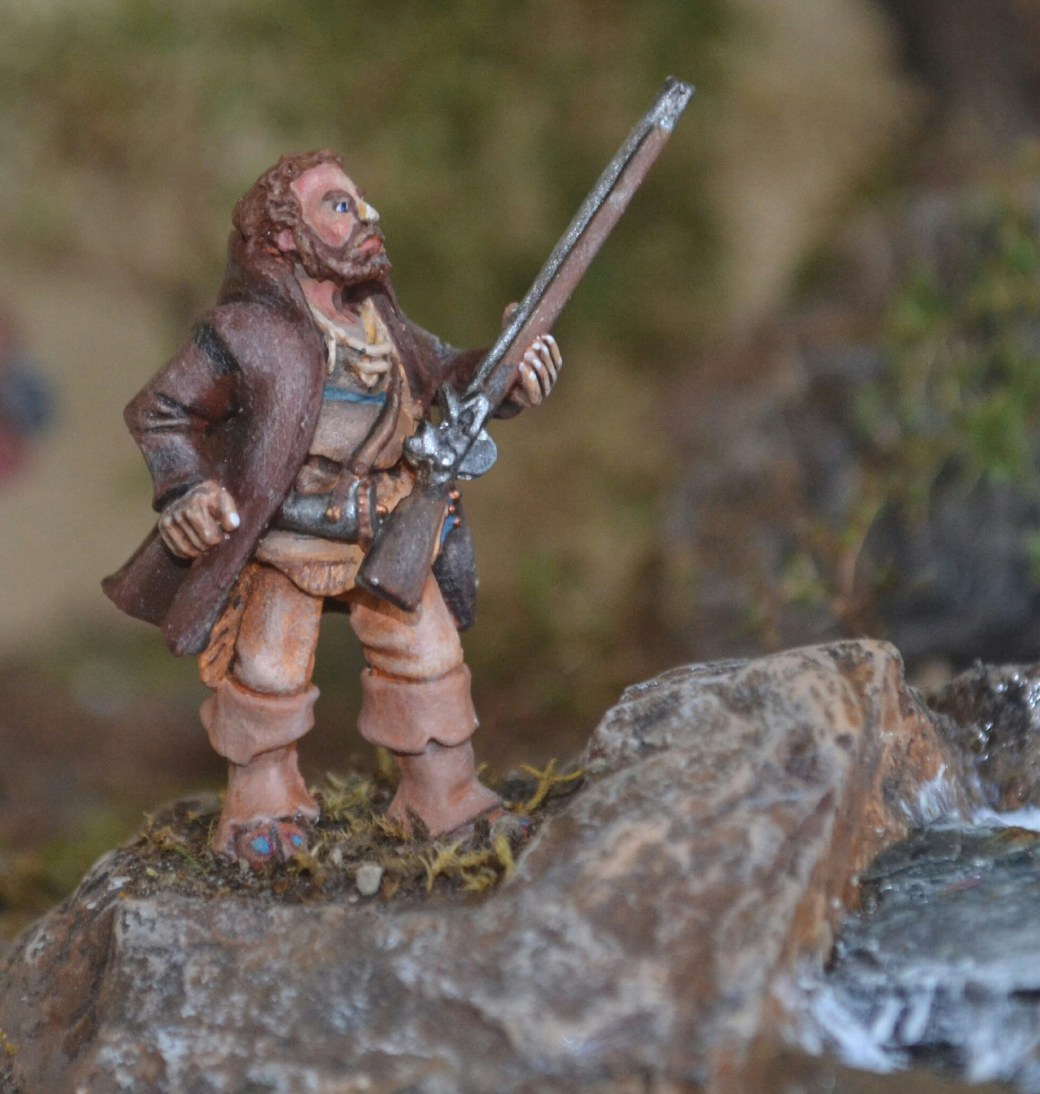
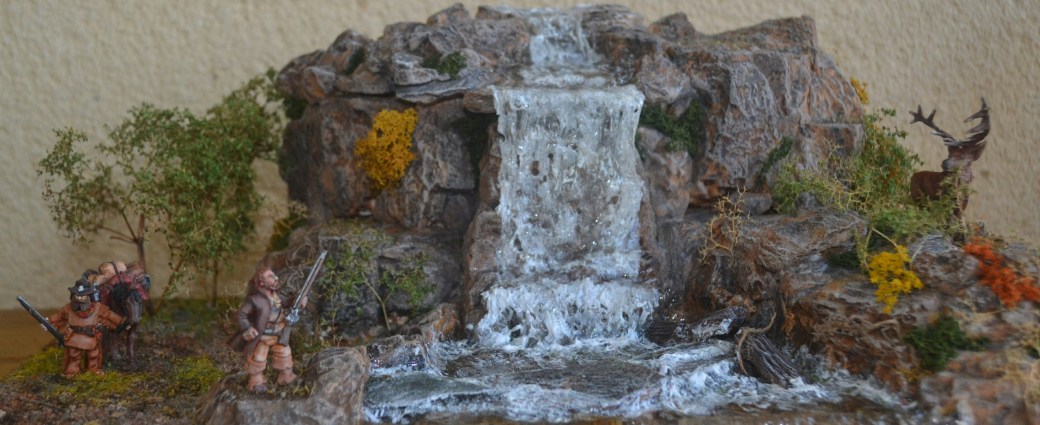
The basic story behind this 28mm diorama is mountain man sees stag across the water and is trying to make his mind whether or not to shoot such a magnificent beast. The stag on the other hand is deciding whether or not to leg it!

Rock moulds from Woodland Scenics were used to elevate the background and produce the height for the waterfall. The waterfall was created using a combination of Woodland Scenics Realistic Water and Water Effects. Woodland Scenics have an excellent tutorial on YouTube on how to do this so I’m won’t provide a poor version of my own here.

The rocks were painted with highly thinned oil paints using a spotting technique whereby you dab on  each colour (in this case Burnt Umber and Yellow Ochre) randomly and allow the colours to run into one another before applying a top coat wash of black (Ivory Black). Thinned the paint finds its way into all the nooks and crannies of the well-defined rock face but it’s not until the black is applied that the rock face truly comes to life.

Various bits of foliage were added to the scene along with rocks and tree debris to the plunge area of the waterfall.

For a change all the figures didn’t come from Dixon’s but from War Game’s Foundry, their Abrasoka Mountain Men set. The chap holding the rifle at the front of the diorama a is a great casting and one of my favourite figures.

So less chat and a few images.

TIM

20141214_13535620141214_13533420141214_135406Mountain Man20170322_115336

28mm ACW Confederate Cavalry Diorama – Part 2

With my holiday looming I finally managed to complete this diorama and without rushing it. When I return from a holiday I’m usually full of new ideas so I was keen to clear the work bench before I go.

Not sure there is a lot to say about this one. Overall I’m pretty pleased with it and broadly speaking managed to create the scene I was after. The figures were all from the ACW range produced by Dixon Miniatures (I wonder if they will ever get to see what I do with the figures I have bought from them?). Other than some minor adjustments to each of the horses to free their legs from metal grass tufts used to keep them on their bases they are as purchased.

One of the things I like about Dixon’s is they sell their figures individually. A lot of manufactures tend to sell in bundles which is OK but I usually find I’m only really interested in one or two figures and the rest end up unused in my bit box. Just like buying bundles of socks or pants from M&S, there is always a pair or two that are naff which you never wear!

Images of the diorama below, starting with a few progress photos and ending with the final model. Hopefully my holiday will provide an opportunity to improve my photography skills.

TIM

20170712_162335_resized20170718_201028_resized20170720_101516_resized20170723_195140-1_resizedDSC_0031DSC_0040


28mm ACW Conderate Cavalry Diorama – Part 1

Having completed my WW1 diorama I now find myself returning to the Old West, or to be more accurate the American Civil War.  The weather here in good “Old Blighty” is typical for the summer which is to say that it is once again raining in England.  Ideal for modelling I hear you say, so thought I but alas it is the school holidays and the family have other ideas.  She who must be obeyed won over and thus progress on the new diorama is slower than anticipated.  I digress.

This diorama is inspired by figures sold separately or as a diorama by Andrea. Andrea Miniatures produce fantastic figures, mostly in 54mm scale, which are priced accordingly, which is to say they are pretty expensive.  Don’t get me wrong I am happy to spend money on my hobby and I do (no dearest, these were a bargain and cost very little for how good they are) but on this occasion I thought I would try to do my own version using 28mm Dixon Miniature ACW figures.  They have a good range of figures for this period and I was able to find what I was looking for with only minor adjustments being necessary.

Base work needed to be done first as positioning of the figures was key so I set about gathering the necessary materials – slate chippings from my drive, dirt dust from the road outside my house, static grass, dried grass from Dartmoor, PVA, water, Milliput and a few minor scenic bits from my modelling drawer and off course paint. Ordinarily I wouldn’t bother to list the items I use, not that it’s a secret but because I’m sure most people have a good idea of what they need.  No, the only reason for listing the items is it never ceases to amaze me that from such an odd array of crap items it is possible to produce something that looks like a reasonably natural landscape.

Enough chat, some work in progress photo’s.  Hopefully I’ll have the whole thing done before I go on holiday in two weeks time.

TIM

20170626_080016_resized20170626_142145_resized20170626_143424_resized20170708_174037_resized


28mm WW1 Diorama (No: 1)

Although most of my models follow an “Old West” theme I do occasionally deviate from the genre.  Sometimes I do so because a model or figure comes along which simply takes my fancy but sometimes there are other reasons for doing so which is the case in this instance.  I shall explain.

Modelling for many of us who are interested in the hobby is often a solitary affair; a great thing to do on a wet and rainy day, of which there are far too many in England. Whilst I am happy to spend hours indulging in my pastime I am if I am being honest more extrovert than introvert and decided I need to engage more with the wider community.  To this end I made the decision to a) create a blog and b) find a nearby modelling club and join it.

The blog is doing OK despite my lack of computer know how and I am aware it takes a while to get these things up and running.  I’m also aware that this is a niche area so I’m not anticipating a life style change anytime soon!  I do now have a couple of followers, you know who you are and I am both flattered and grateful for your comments, thank you. So, objective number 1 is in hand.

So on to objective number 2 and its relevance to the diorama featured in this post. I managed to track down a club in Plymouth and a few months ago went along to my my first meeting.  They meet a couple of times a month with the second meeting being a club competition evening.  There are about 19 members, most of whom I have now met and they are a friendly bunch.  Modelling is a diverse subject made up of various genre’s many of which are represented by the club members.  That said few of the members are figure painters so my work has brought something new to the club.

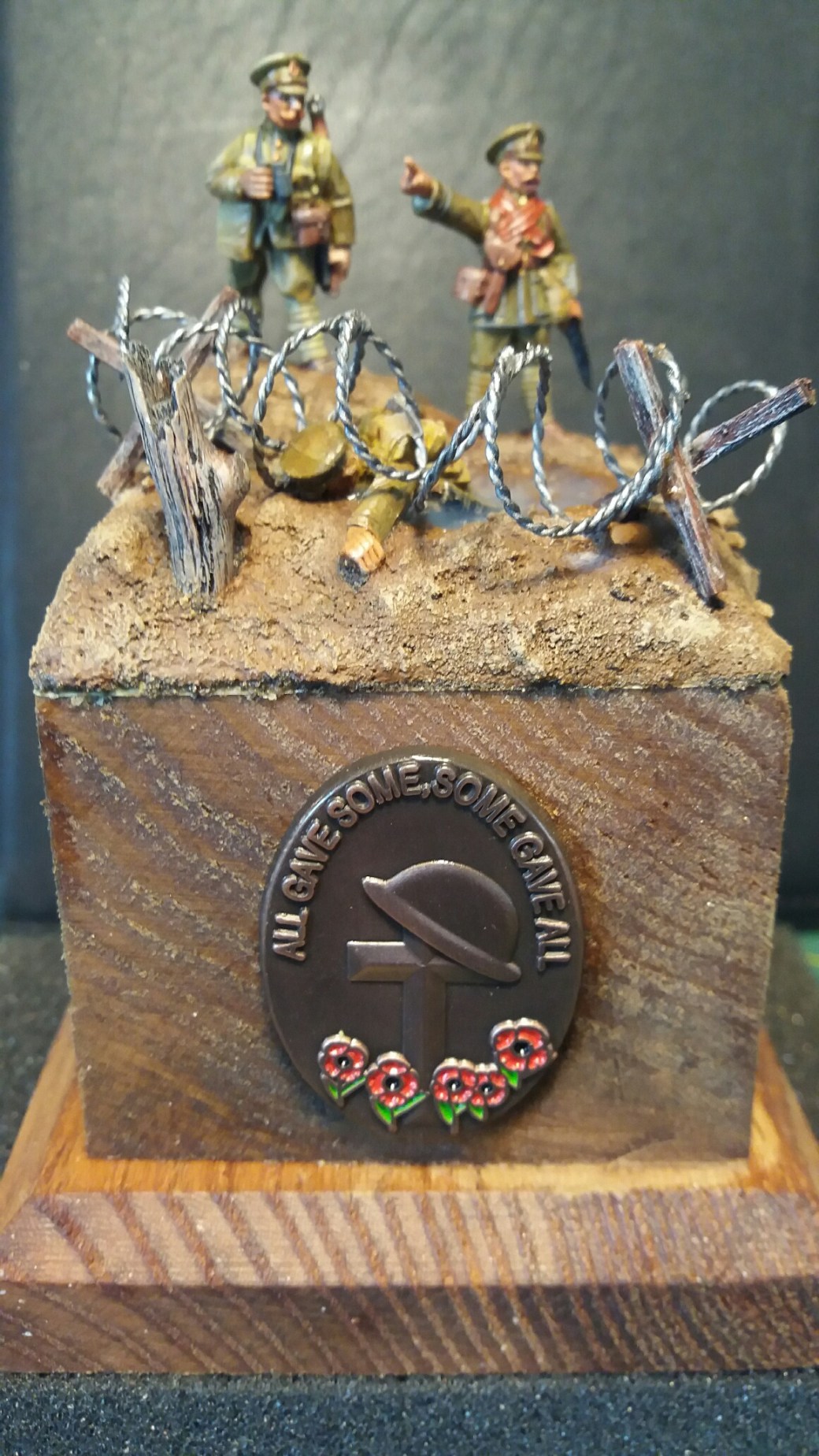
At this point I should perhaps explain to those who do not know that Plymouth is a Naval and Royal Marine city and I think this has influenced many of the clubs modellers who specialise is WW1 and WW2 military planes, ships and vehicles (I on the other hand am a Londoner a who wanted to be a Cowboy!)  The club also holds its own annual Modelling Show in the City and for 2018 they aim to hold the event on the same day that the City holds its Armed Services Day.  As next year will be the hundredth anniversary of the last year of the Great War 1914 – 1918 the club thought it would be a nice idea if everyone produced a model with a WW1 theme.

The images of the diorama below represent my contribution to next years model show.  Military uniforms are not my speciality so apologise in advance for any inaccuracies.  The model was fun to do but I don’t think the era will dominate my future work. Although having said that the idea of doing more diverse subjects has captured my imagination.

A final few comments on the club I joined.  Firstly, I would encourage anyone who is not in a club to join one.  It’s great fun engaging with fellow enthusiasts even if you aren’t into the same genre.  Most, if not all, modelling skills and techniques are transferable and so much more can be learnt in this environment. Secondly, assuming this to be true of most clubs, there is a wider audience via the attendance and participation at other shows.

I went to my first show a few weeks ago and took along some of my own work to display.  To be honest I was a little afraid of what people might think of my work but having had a lot of positive feedback at club nights, and competition nights in particular, I went along with a positive out look.  It turned out to be a great day, met and spoke with a lot of new people, picked up some great tips and received a few accolades along the way.  One chap even took photo’s at the event and put them onto a YouTube video.  If anyone wants to check it out then search for “Helicopter Museum Model Show 2017” there is a part 1 (which features 7 images of my models which blew me away) and part 2.

Images of the diorama – in progress to completion – below, hope you like it.

TIM

20170726_114208_resized

20170728_233041_resized

20170728_232937_resized

20170729_180907_resized

20170729_144842-1_resized

20170729_144733_resized


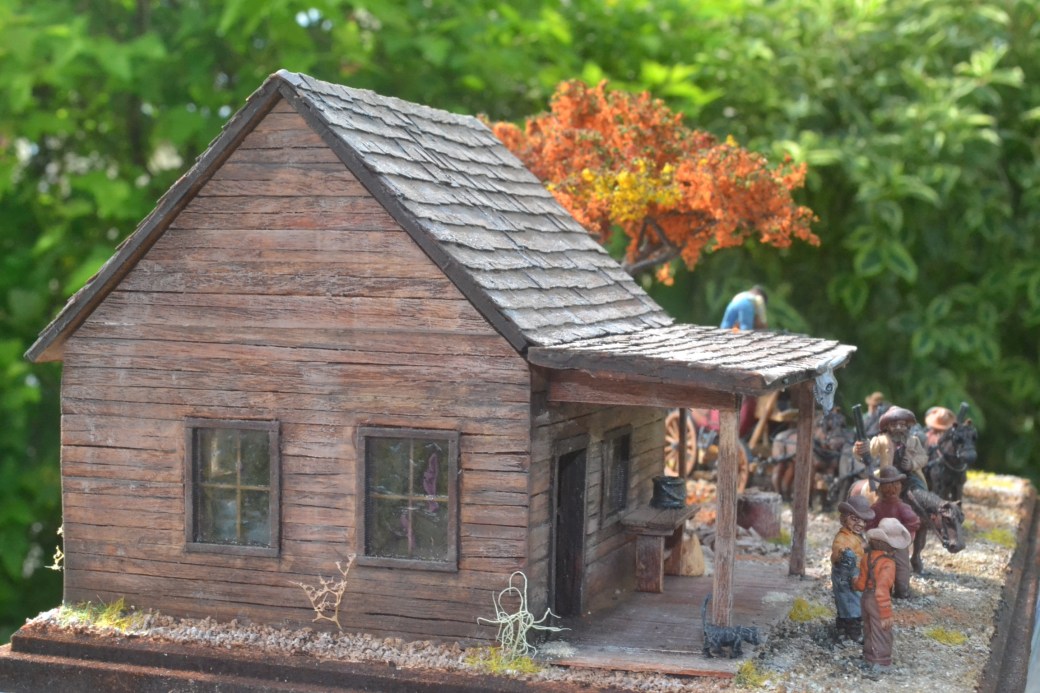
28mm Building Project No: 6 – Wells Fargo Way Station

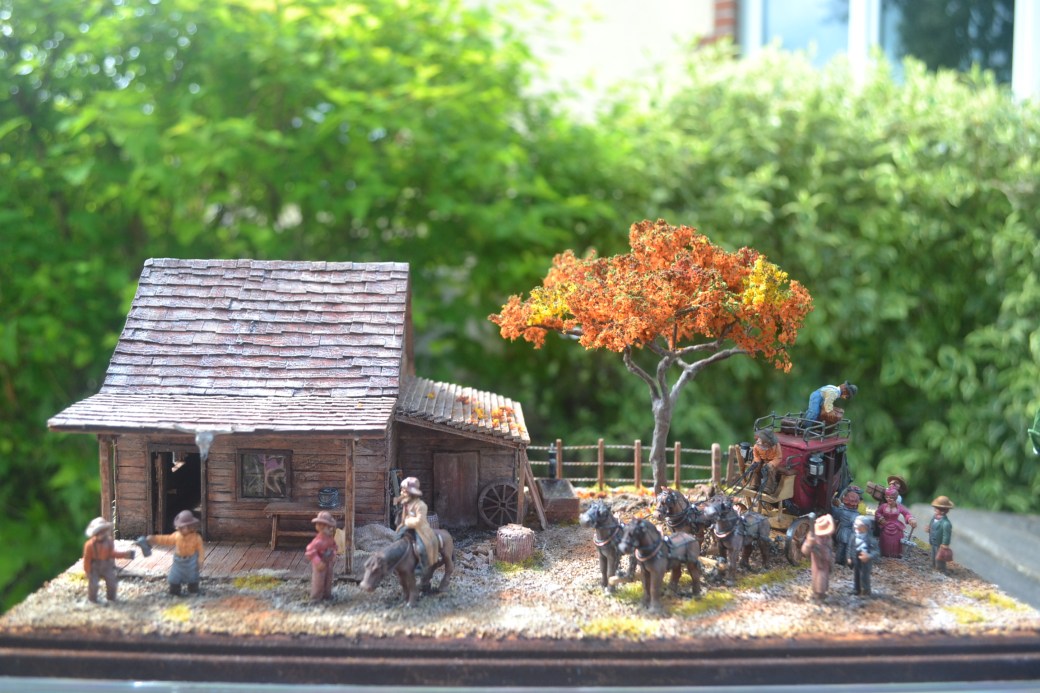
Few images of the Old West more classical than a Wells Fargo Overland Stagecoach and Dixon Miniatures produce a fantastic kit.  Having constructed one of these kits for my brother’s birthday some while ago I always had it in mind to build another for myself, it was always just a matter of time.

I decided the stagecoach would feature in a diorama and chose to depict a Way Station where passengers leave and join the stage and where drivers and horses rest up a while. Space as ever was a constraint but I wanted this to be a diorama of firsts, reflecting if you will my growing confidence at scratch building.

I had never built a wire tree before, made a wire fence, constructed my own internal furniture or completely constructed my own building with a removable roof but that was about to change!

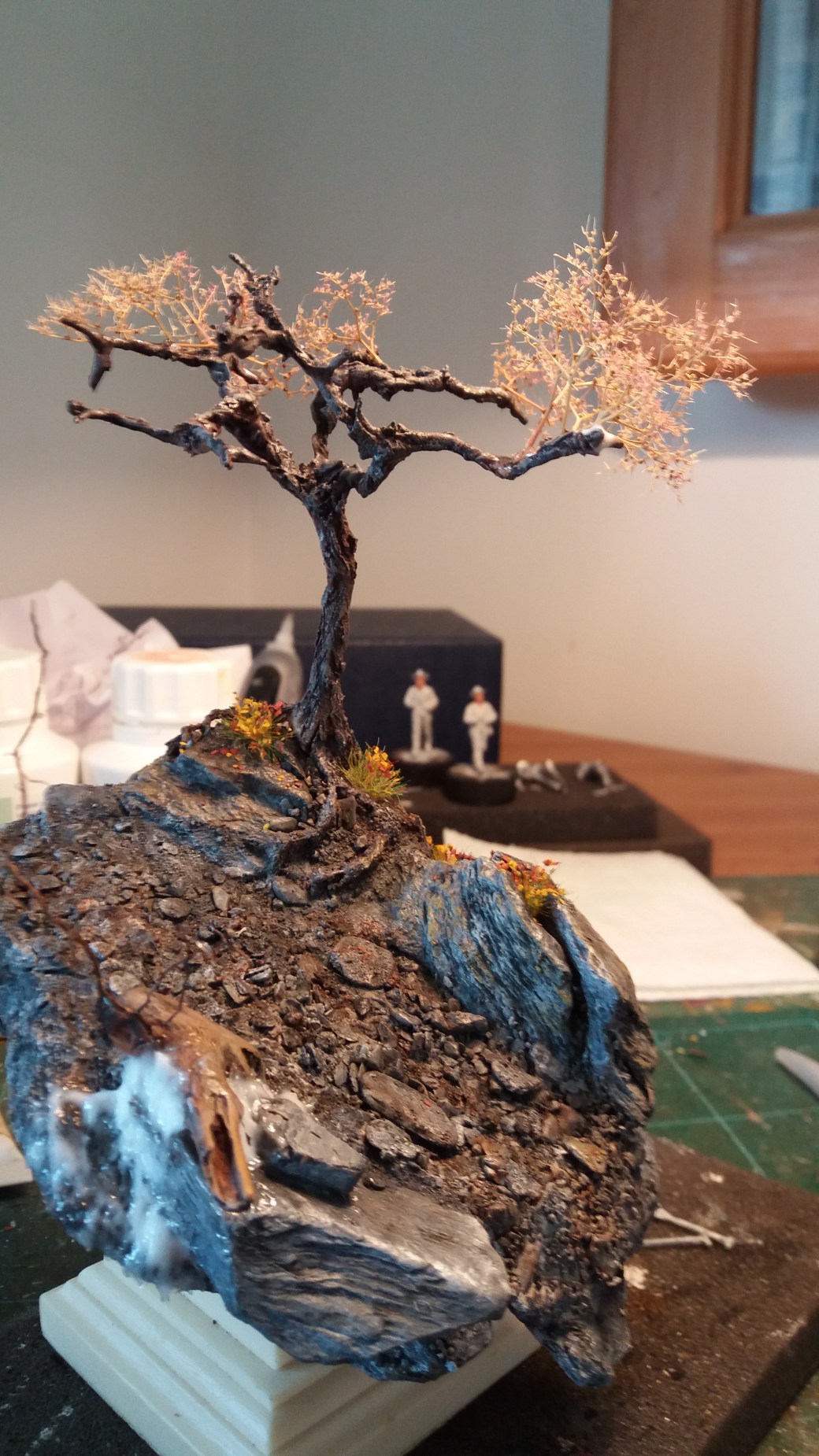
Following a video guide I found on YouTube the first thing I built was the wire tree.  I wont go into further detail on this because I covered the process in two recent blog posts. YouTube was also the provider for how to make a wire fence.  The fence posts themselves were match sticks each drilled with three holes.  The wire was real wire 0.5mm thick.  A length of about 12 inches/30cm was folded back on itself  and then the two separate ends were clamped together tightly (a vice is good for this).  I used a nail placed at the looped end to pull the wire tight  and then twisted and twisted and twisted … you get the idea … and twisted until the wire became taught. Simple but very effective.  The wire was then threaded through the holes on the fence posts.

Anyone who has followed my earlier posts may recognise that the building looks pretty similar to those produced by Sarissa Precision which I have used in the past. There is a reason for this.  When you by one of their kits they come in a couple of MDF sheets (more for bigger buildings) of about A4 size.  Each sheet has the various parts which make up the building which once pressed out leaves the complete outline of that part which can then be used as a perfect template for creating your own scratch building.  In my opinion Sarrisa Precision make quality products at reasonable prices, their range has grown and grown too.  If you think you might use one of their designs more than once, or there is a design that you could easily modify, then buying one and keeping the empty sheets for future builds is a cheap option.

So back to the building.  Using the template of a previously purchased building I set about constructing the various parts using my now tried and tested method of foam board, coffee stirrers, cardboard, match sticks (extra long matches for the veranda posts) and PVA glue.  The lean-to on the side of the building was my own design addition.

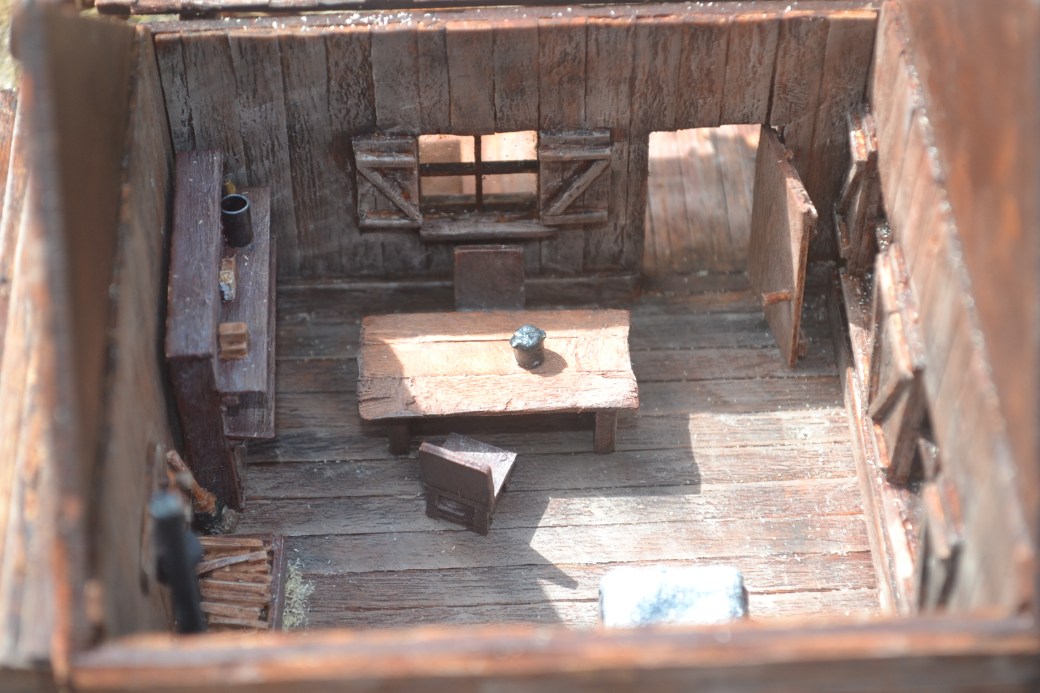
For this building I planned for the roof to be removed in order to look inside.  With this in mind it was necessary to clad the inside of the building with coffee stirrers too and to make frames to cover the “glazed” windows and add wooden shutters as well. The window shutters and the door were given “Z” frames for appearance and practical build reasons.  The door handle was made by drilling a whole in the door and inserting a small piece of a cocktail stick.

All of the furniture was scratch built.  The bed was made using a combination of match sticks and coffee stirrers (as was the wooden log box) and a dried out wet wipe dipped in diluted PVA was used to make and mould into shape the bed pillow and blanket.  The table, chair and dresser were all made of various combinations of match sticks, coffee stirrers, cocktail sticks and other bits I found lying around.

The wood stove was my favourite build.  It was made using a piece of round wooden dowel with a round metal washer as the base.  Two metal washers, one larger than the other, were stuck together to make the top of the stove along with a small piece of rounded card to close the washer whole.  Another small piece of card was used to create some relief on the dowel to make a door and a pin head was used to make the door handle.  A wooden BBQ skewer was used to create the stove-pipe and a piece of tubular plastic taken from one of the protective covers which comes with good brushes was used to create the joint.  It was then all undercoated before being painted black and weathered.

The coat hooks were made using the ends of cocktail sticks, the hat was taken from an unwanted figure and the rope was made from some thin string.  The broom was made from a thinned match stick and the hair of an old brush.

Outside, the barrels were some spares I had in my “bit box” and the log pile was simply made from various left overs made smaller with a modelling knife.  If like my brother you are wondering why there aren’t any tools lying about then I will give you the answer I gave him, “they’re all neatly inside the lean-to!”.  The water trough was made of coffee stirrers, filled with Woodland Scenics Realistic Water and the pump was made from wooden skewers with a paper clip handle.

The figures are all once again from Dixon Miniatures with no alterations made.  The stagecoach does not come with chains and harnessing so this was all made from scratch.  The chain was purchased from Hobby Craft and cut to length.  At each end a pin shortened in length was attached and a hole drilled in each horse to accommodate it when stuck together.

Assembly required a lot of thought.  With so many pieces it would have been easy to box myself in and have very little room, if any, to access and paint as required. fortunately I got there in the end!

Images of the completed diorama appear below.

TIM
DSC_0018DSC_0027DSC_0019DSC_0019DSC_0022DSC_0026DSC_0030DSC_0029

Off The Work Bench – American Civil War 28mm Diorama

Much of which I could say about this diorama has already been covered in earlier posts under the header “On The Work Bench” so I wont bore anyone by making further reference to making the tree, the covered bridge and the small section of river.  That said more than happy to answer any questions on the subject.

The diorama itself is meant to depict confederate infantry men making way for the limber coming through and hopefully that comes across.  The figures are once again all from Dixon Miniatures and apart from adding harnessing to the horses and limber are as purchased.

Assembly on this scale and with quite a few pieces proved a little tricky but I got there in the end! Various scenic details were added, most notably the grass which was applied using a static grass applicator.

TIM


Off the Work Bench

I was recently given a Pegaso 54mm Comanchero by a guy who didn’t consider himself to be a figure painter. Although my American Civil War diorama is very near completion I thought I would have a break from 28mm figures and paint it. It has been a while since I have painted a 54mm figure and it surprised me how big it was!

An enjoyable project and a welcome distraction but back to finishing my diorama.

Is it just me or am I the only one who has more ideas on what to do next than I have years left to live to complete them?!

28mm Building Project No: 5 – The OK Coral

For my 5th Building Project I drew inspiration from one of the great legendary moments in Old West history, The Gunfight at the OK Coral.  As much as possible I wanted to be true to the actual events and location but to create a model which worked for me and my limited base space it was necessary to invoke an element of poetic licence.


Diorama in development

Without turning this into a history lesson, the fight (some might say murder) took place in a vacant lot between two buildings.  Fly’s photographic Gallery was actually at the back of the lot but is usually depicted at the front, presumably because the building was of greater interest and I have done the same.  The righthand building was actually an old wooden house but as I did not have the space and wanted to create the feel of a vacant lot I chose instead to make it a small barn/out building.

The small out building was built from scratch using the same method as Building Project No: 4 – foam board sides clad with coffee stirrers and roof made of cardboard with cardboard shingles.  It was then painted using a variety of oil paint washes (for details refer earlier posts).

Fly’s Photograpy Gallery started life as a Sarissa Precission kit.  The kit was assembled and then completely clad on the sides with coffee stirrers and on the roof with card board shingles.  The doors were also remodelled.  After drying it was painted with oil paint washes.  Clear plastic was used to glaze the windows and blinds were added, the aim of which was to restrict the view looking into the building as on this occasion I did not plan to fit out the inside.

Signage was made using a downloaded Western font and then printed in black and white using Word.  It was then given a thin wash and a bit of weathering.

The figures used were once again all from Dixon Miniatures.  Virgil Earp (kneeling) was given a walking cane (a pin) and Morgan Earp (lying down shot) was given a new hand holding a gun.

Images of the final diorama appear below.