Kelly’s Heroes – 28mm Artizan Figures (The October Challenge)

The Azazel challenge for October was to complete a unit of at least 3 figures and/or an Ork for Orktober.  As I typically do single figures, vignettes and dioramas unit challenges don’t naturally fit with what I do.  Having said that I love the challenges and whenever possible like the idea of contributing something.  With so much to do at the moment I limited my self to the unit challenge only, I’ll have a crack at an Ork some other time, might even call it IRO!

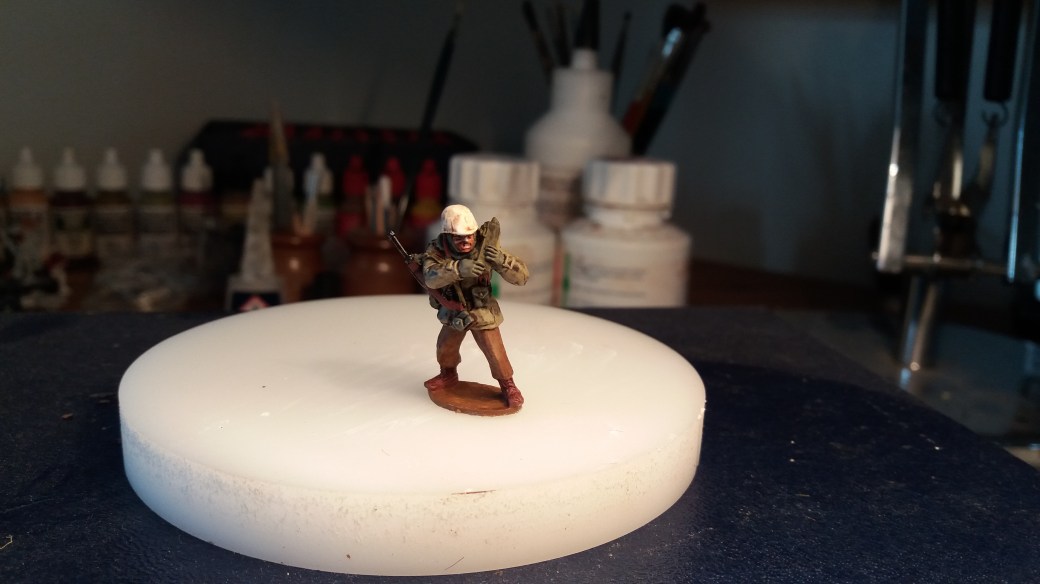
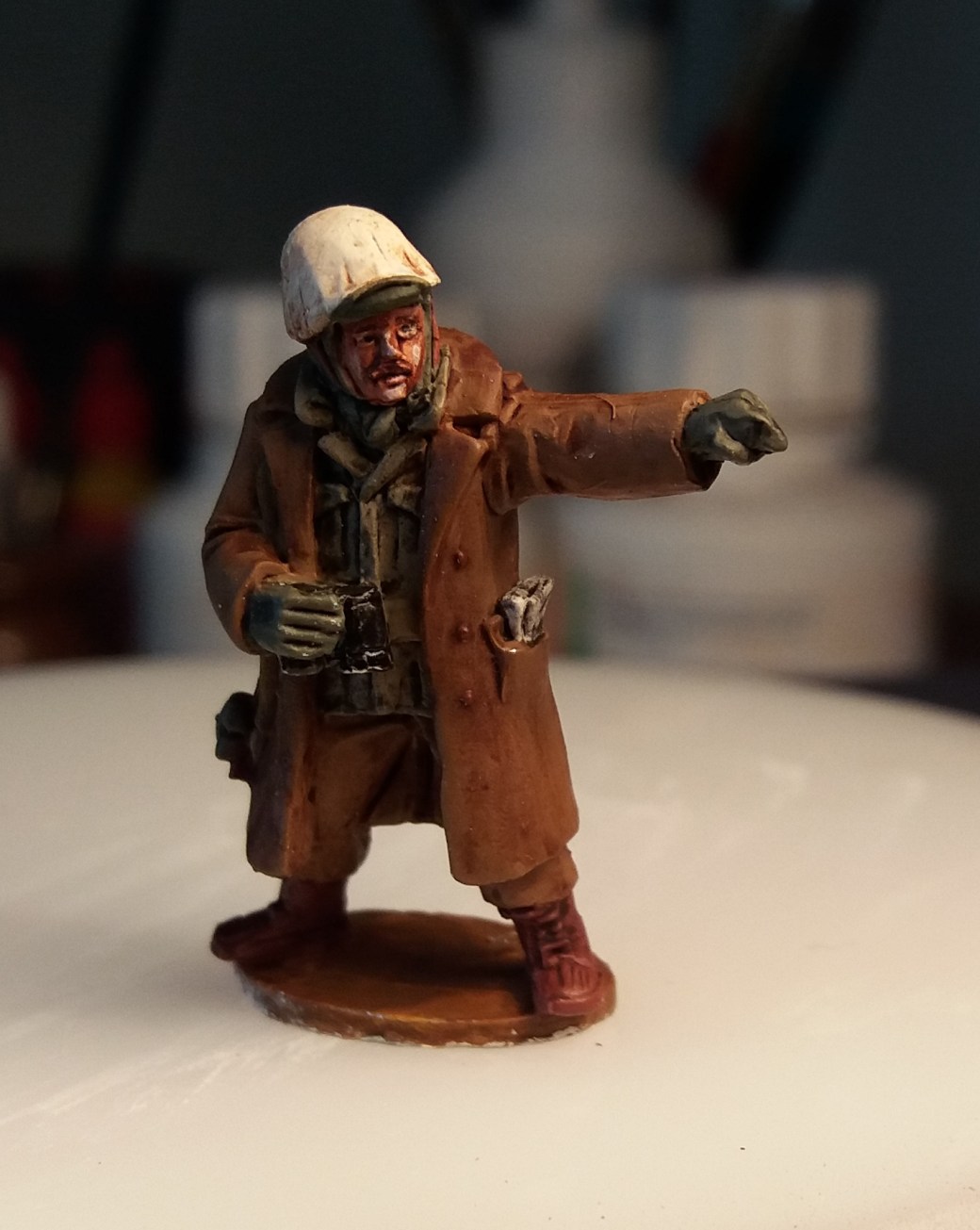
I didn’t really have any idea what to do for a unit but when I was searching the Artizan website for something else I discovered this 28mm three figure set representing the primary characters from the classic film Kelly’s Heroes.  So here we have Kelly, Big Joe and Oddball.  I’m not sure Kelly or Big Joe are great representations of the actual characters either in sculpting terms (like I have the right to be critical!) or in respect of my paint job but the sculpt of Oddball is excellent in my opinion and unmistakably “him”.

I suspect I am not alone in nominating Oddball as my favorite character from the film so for a little added nostalgia a few Oddball classics lines …

“A Sherman can give you a very nice… edge”

“Crazy… I mean like, so many positive waves… maybe we can’t lose, you’re on!

“I’m drinking wine and eating cheese, and catching some rays, you know”

“It’s a wasted trip baby. Nobody said nothing about locking horns with no Tigers”

Images of the three figures below.

TIM

DSC_0001DSC_0002DSC_0008DSC_0009DSC_0007


Operation Overlord – A 28mm WW2 Diorama (Part 1 – Building No: 1)

Introduction

The Plymouth Model Club has chosen D-Day as the theme for next years show, an exhibition to mark the 75th anniversary of the invasion landings.  All the club members have plans to produce something and for my part I thought I would, in addition to a few other models that I will produce, make a sizeable diorama.  If I manage to pull it off then it will be the biggest diorama I will have done.  Not necessarily the most complicated but certainly the biggest.

It will also be time-consuming to produce so this will most likely be the first of a number of posts on this project.  I will post regular updates but for my sanity as well as yours I expect I will work on a few other things in parallel and vary my future posts accordingly.

So what do I have in mind to put together?

The concept is a simple one and one which may well evolve a little as I begin to make progress.  The plan is to have three, possibly four, buildings representing a small street scene with troops from the 101st US Paratroop making their way carefully along the road.  Dimensions and aesthetics will play a part in the final design.  Written down I can’t believe how shit this concept sounds but the image in my head is much better so at this stage you’re just going to have to trust me!  The devil will be in the detail as I hope you will come to see.

Key to the diorama will be the buildings.  Initially I thought I would do my own completely from scratch but windows in particular are a nightmare.  I then decided to buy a kit from Charlie Foxtrot, ironically a company I discovered at this year’s Plymouth show where Colin, the owner had a display.  If I like the end result then I will purchase the remaining buildings from him too.

So let’s get this series underway starting with the first building.

The Kit – Ruined House No: 2 by Charlie Foxtrot Models

Below is a picture of the actual kit as it appears on the website.  It’s probably easier to look at the pictures of how it is designed to look than for me to tell you, particularly as I have plans to make a number of changes.


The link below will take you to this kit on the website and to the online shop if it’s of interest to you.

28mm 1:56 "Ruined House 2"

Looking at the kit you may well be asking yourself why would I want to make changes to what is essentially a highly detailed kit?  There are two main reasons.  Firstly the kit is made of MDF which is a great material for accurate laser cutting and etching but the finish is flat and characterless.  Secondly, whilst the kit is probably ideal for war gaming in that it neatly comes apart it is not detailed enough when it comes to being a feature of a diorama (well not for me at least).  This will probably become clearer as the construction of this kit gets underway.

I mentioned earlier that my plan is to have at least three buildings.  This is the first of the them and I expect it will prove to be the most challenging, mainly because it will require internal changes and enhancements in addition to an external makeover.  I’ll explain why as the build progresses.

Time for a couple of photos.

20180926_14094520180926_14112720180926_141944

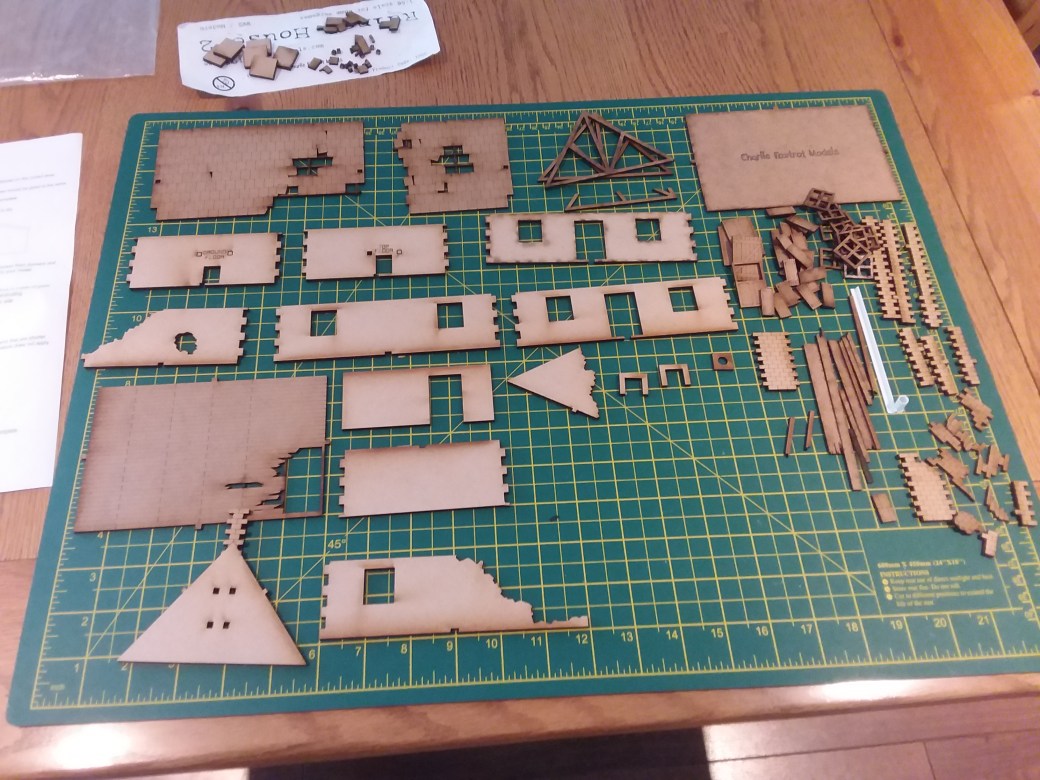
The first picture shows an image of the kit unopened in its bag.  The second and third show all the bits neatly laid out as I try to work out how the hell it all goes together.  A single A4 sheet of instructions is provided and to my surprise it did prove to be sufficient coupled with a bit of common sense and a few references to the online images on the Charlie Foxtrot website.

The model when assembled is meant to consist of three parts.  The ground floor, the first floor and the roof.  Because it is a war gaming building it is also meant to come apart rather than to be assembled as a solid single construction which is what I will be doing with it.  My first consideration therefore was to determine if it would be possible to see inside the ground floor.  If it was then I would need to make changes at this point as access to this area would not be possible once the first floor was added.

I decided it would be possible to see a little bit inside through the windows and through the hole in the ceiling as you look down from the first floor but I couldn’t be sure just how much.  I therefore concluded that some internal fitting out was necessary, just to be on the safe side at least.

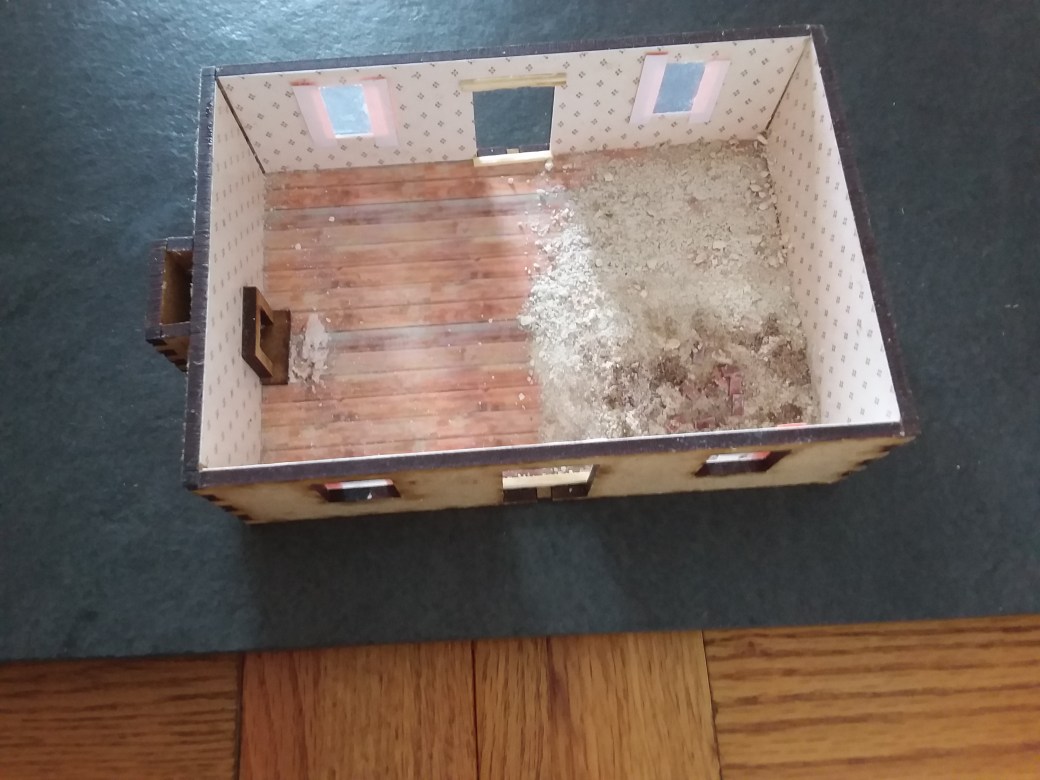
The first thing I decided to do was wallpaper the internal walls.  On a “Dolls House” website I found some free wallpaper downloads.  I chose a small print for scale purposes and printed a couple of sheets on to photographic paper.  Photographic paper being thicker would glue better to the walls and would not make the inks run.  Each wall was “papered”and the floor too was covered with a wooden floor board print which I also found on the same website.  Normally I would use coffee stirrer’s for a wooden floor but didn’t think that was necessary on this occasion given how much would be seen.

20180926_16242420180929_132627

The next step was to glaze the windows using clear hard plastic.  Pieces were cut and stuck to the inside of the walls.  The windows would go in later after they were painted.  Completing the glazing at this stage would also stop the windows from falling into the building when assembled when it would be harder to get them out if that happened.  I also made one of the windows with “broken glass” by simply cutting the clear plastic accordingly.  Using some paper painted with acrylic paint I also made curtain for the windows which would be visible from the outside looking in.

20180929_132641

A similar problem to the windows existed with the front and back doors so to prevent them from falling in when it was time to fix them in place I glued matches to the top and bottom of both the door openings.  When the first floor is in place there is a hole in the floor which looks down and into the ground floor.  Now was the time to put debris in place so ground plaster board along with a few scale brick and pieces of timber were added.  At this stage the modified ground was complete and duly assembled.

The next step was to direct my attention to the first floor.

The first floor is divided into two rooms, one of which represents the damaged end of the house where the roof above the floor has been blown up.  Now the first thing I noticed with the kit design was that you could look into both these areas.  In itself this would not have been a problem except for the fact that the kit has no internal staircase.  This bugged me and so the only way I could see to get around the problem was to put a ceiling above the undamaged room (if anyone asks the staircase is on that side of the house!).

The ceiling was made using wooden coffee stirrer’s stuck to a piece of MDF which was cut to size.  The ceiling piece had to be inserted rather than simply laid on top as this would have thrown out the fit of the roof at the next stage.  For support coffee stirrer battens were positioned at the top of each of the four wall sides.  Having created a ceiling for one half of the first floor it was appropriate to make a damaged one for the other side too.  The first floor was also wall papered and glazed in the same way as the ground floor.


20180929_13272920180927_18182820180930_15061020180930_150659

The sharp eyed among you might notice that I have Peter Gabriel on in the back ground!

The next stage was to look more closely at the roof assembly.  The only thing which really needed to be addressed was the tiling.  I don’t like flat roofs and do not have the skill to produce 3D style painting so there was nothing to do but cut out several hundred cardboard tiles and glue them row after row to the MDF.  I’ve done this several times in the past and my method is tried and tested.  With suitable music or a DVD on it doesn’t take that long to achieve.  To make the tiles I used my Greenstuff World tile punch and cardboard from a cornflake box.  I find it is best to use cardboard where one side has a gloss finish.  The gloss finished side should be facing out when the tile is stuck down.  This is better for painting.  The other way around and the cardboard turns to mush if you aren’t careful.

Finally the two wall ends of the roof were rendered on the inside using ground plaster board on PVA glue.

20180930_150801

Following a little painting of areas which would prove difficult to paint if not done now the three components of the kit were ready for assembly.  The assembly itself was very straight forward, testimony of the quality of the kit.

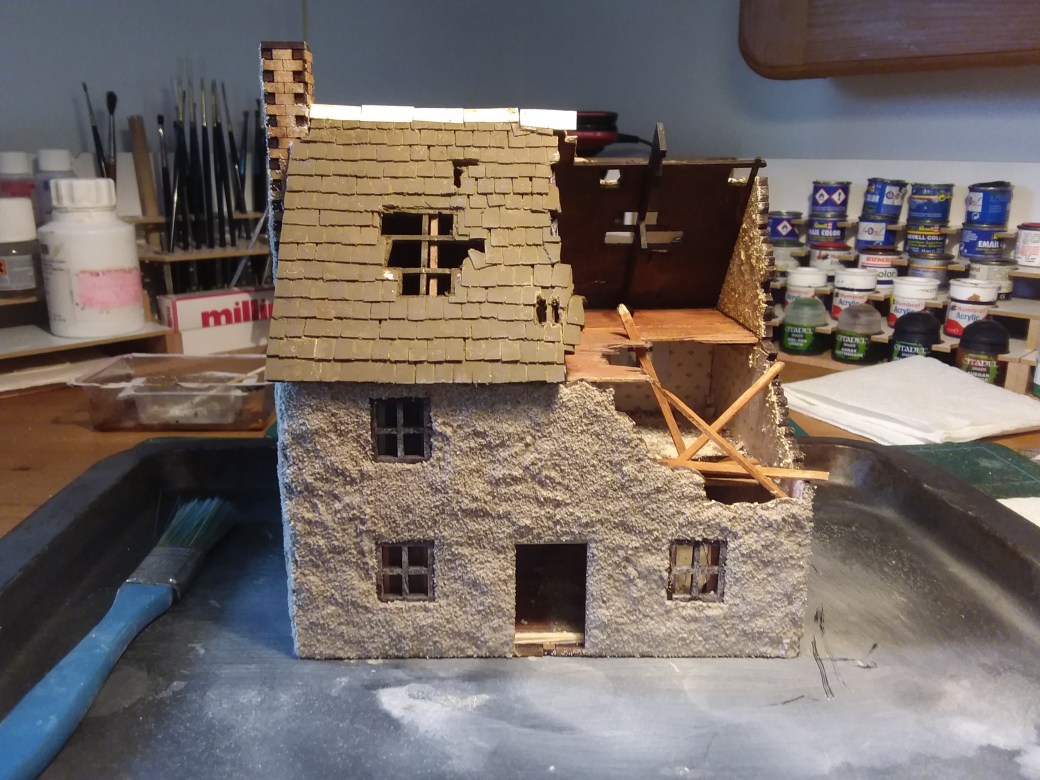
The next job was to glue the windows, which had now been painted, into place.  This was then followed by adding some initial bits of debris to the first floor and then rendering the outside walls.  The rendering was done over several days as each side was allowed to thoroughly dry before moving on to the next external wall.  Diluted PVA was used on the outside walls before chinchilla dust (yes, chinchilla dust!) was applied to the outside.

20180930_22212320181001_16180020181001_16182220181001_161811

The damaged wall kit pieces came with small MDF brick sections which could be stuck on.  As with the roof tiles the brick looks very flat so I simply decided to go with ground plaster board to provide a rough cast finish to the top edges of the exposed MDF.

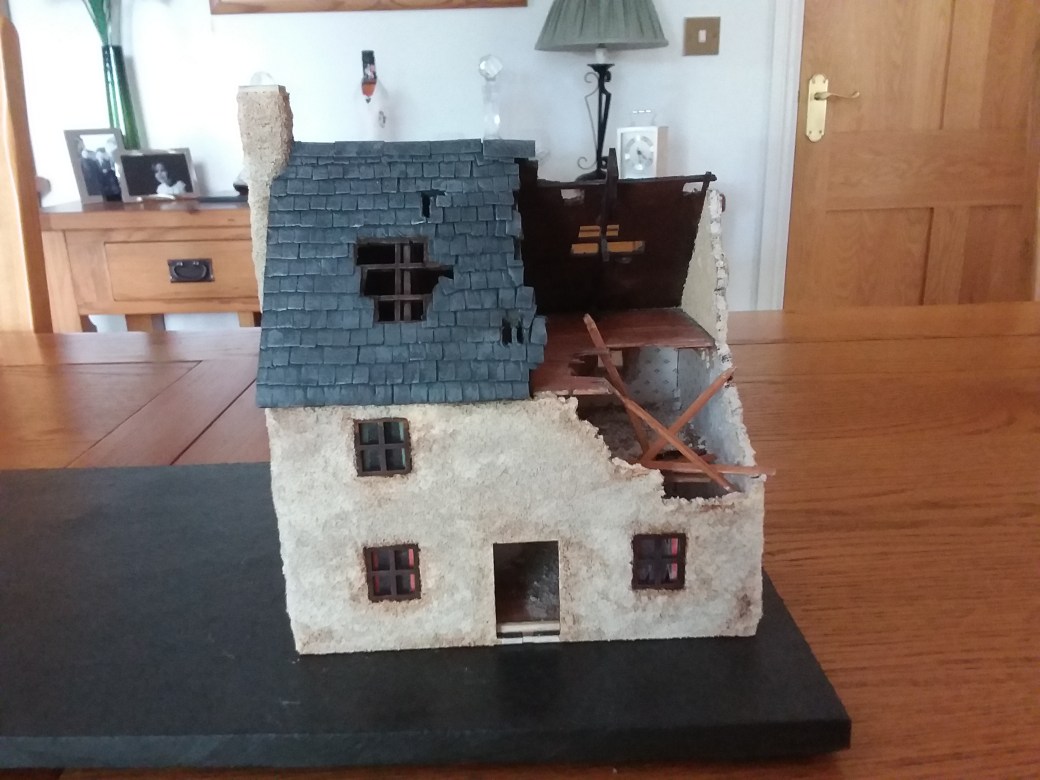
Once it was all dry I painted the render with some Dulux Emulsion paint and used Burn Umber oil paint heavily diluted with white spirit to provide some initial weathering to the walls.

The completed model to date is shown below.  It is not finished.  The render needs to be weathered further, the window shutters need to be fixed in place and so do the doors.  At this stage I’ve yet to decide which windows will have open or closed shutters and the same goes for the doors.  These are things I will look at more closely when I make further progress on the rest of the diorama.  Scattered debris of brick, tiles, wood and broken glass will be added to the inside and outside at a future assembly stage but for now I have done as much as I can do on this one.

The next step is to order the remaining buildings for the diorama having decided I like Charlie Foxtrot’s kits.  While I’m waiting for them to come I can divert my attention to the October challenge!

Images of the current state of play below.  It doesn’t look very impressive at the moment but there is a long way to go!

TIM
20181004_16281120181004_16263420181004_16262020181004_16260420181004_162656

WW2 Rubicon 28mm Willys Jeep – (The April Challenge – Project No: 1)

An early entry for the April challenge under the banner of “build or assemble something”. This was not my planned entry, details of which will follow later in the month, this one was an accident.  Let me explain.

For quite a while now I have wanted to attempt a plastic kit.  I reckon it must have been the best part of 45 years ago when I last did one.  Why?  Because I loved the look of some them all those years ago, as indeed I do to-day, but I simply don’t enjoy making them.  My willingness to have another go was fuelled by my desire to try to encourage my model club who are well into such kits to base them, even simply as is the case with this one.  The passage of time also helped, it couldn’t have been that bad all those years ago could it?  Alas it was and readers of earlier posts will be aware that this little project was in danger of going tits up and being abandoned altogether.  Then the April challenge got me refocused on getting it done.  I figured if I was going to do it then I might as well kill two birds with one stone.

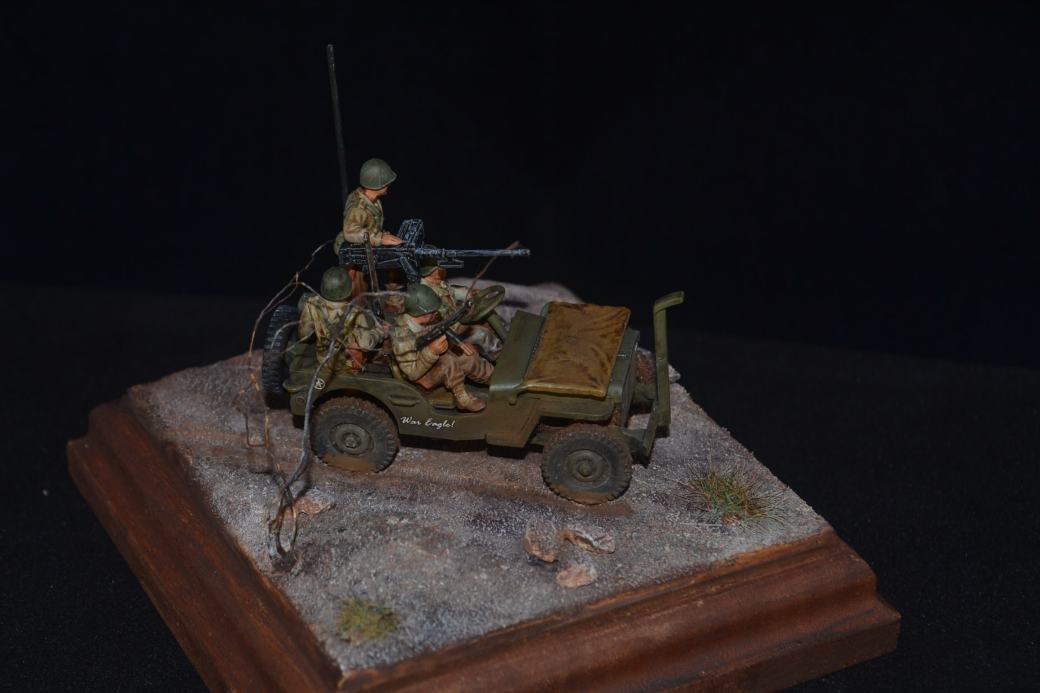
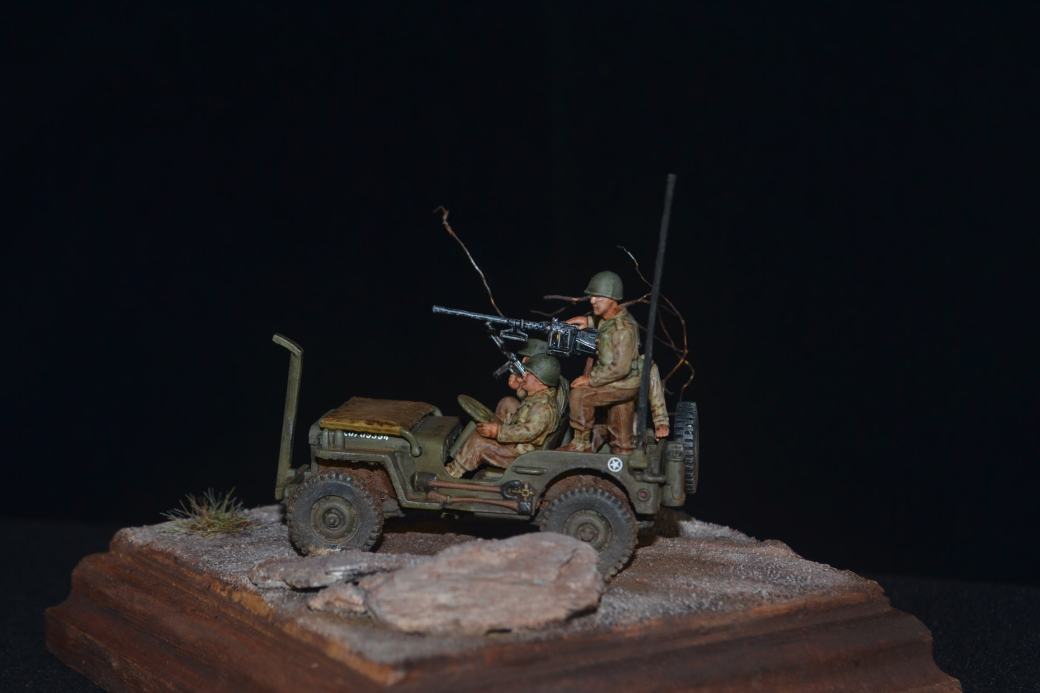
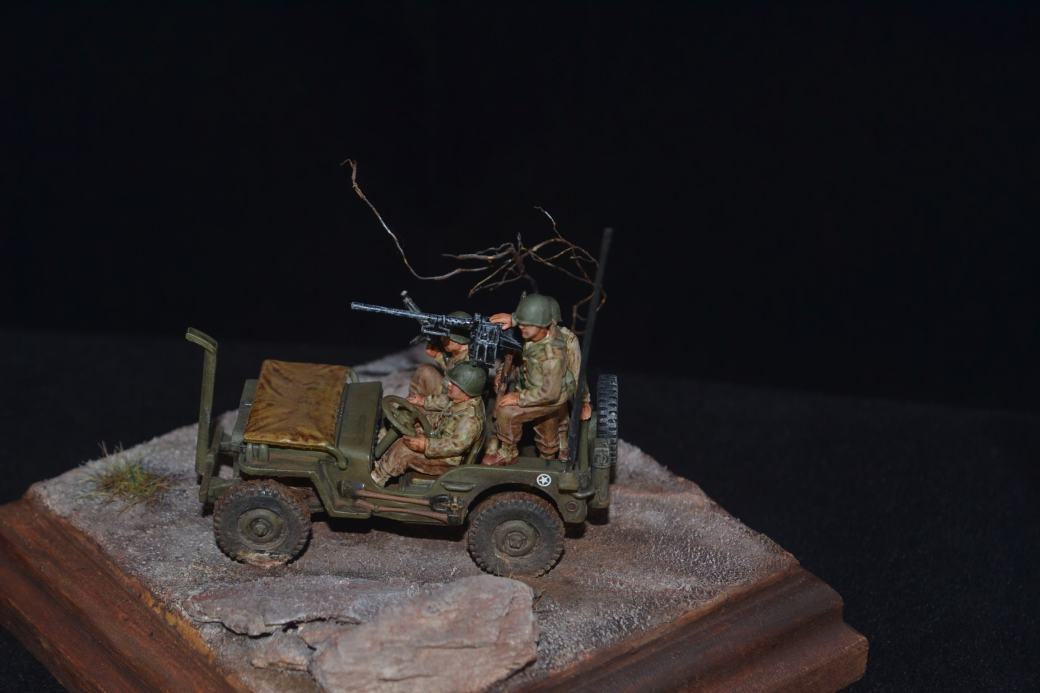
Pictures of the completed piece appear below and the eagle-eyed amongst you might notice that there are no “in progress images”.  There is a reason for this.

As I have mentioned previously I am not a vehicle kit person chiefly because me and glue simply do not see eye to eye.  I was dreading the build rather than looking forward to the challenge that lay ahead.  Nevertheless I was determined to complete the exercise come hell or high water but had no desire to record this momentous step by taking progress photos of deformed plastic covered in blobs of glue.

So how did it go?  Better than I thought but not great.  Were my worst fears justified?  Not the worst ones but the ones just below the worst ones.

The first issue I had was shortly after I opened the box and started to assemble the kit.  It turns out this Rubicon kit can be assembled into one of four configurations.  Being a man I don’t tend to read instructions so this point initially passed me by.  However, I got lucky.  I wanted to build the US version and without realising it this is the one I had started on when I discovered all the additional parts that I couldn’t work out what to do with.  Score – 1.

After eventually reading the instructions, assembly to be fair was pretty straight forward and the fit of parts were good, not that I have much previous experience on which to judge this.  I even managed to think to paint areas before assembly and to add things like mud to the wheel arches before fixing the wheels themselves in place.  Score + 1.

Unfortunately some things hadn’t changed, I’m still heavy-handed with glue.  As light a touch as I might have with a brush the complete opposite is true with glue.  Alas trying to apply super glue with a modelling brush which would be the ideal solution for me is simply a way of ruining a brush.  So, crucially glue everywhere, Score – 10!

I had hoped the figures would be my saving grace and although they were OK the faces left a lot to be desired.  I’ve been lucky of late in that a lot of the miniatures I have been working on have been superbly sculpted and the expressions on the faces have been simply awesome.  As a consequence I have been able to get away with my painting skills.  Unfortunately the faces of these figures were plain, very flat and featureless and although I felt I made the most of them the end result still left a lot to be desired.  Score + 1.

Final assembly of the kit including the figures went together better than I had hoped but for one error.  I’m not sure if the error is with the kit or with my assembly.  Having googled some images of completed kits done by others I think I can be certain the error is mine but quite where I went wrong I’m not sure.  The error in question is with the rear sitting down soldier and the way he is holding his rifle.  He’s holding it far to low down and although I was aware of this at the time I simply couldn’t get it higher and get the figure sitting in the back of the jeep.  Still that’s why I’m The Imperfect Modeller!  Score – 1.

On to something positive, the base work.  Now there is nothing much to the base, it’s all pretty basic and that was the intention, to keep it simple as a demonstration piece for presentation at the club.  However, if there is one thing I have learnt, albeit with room for improvement, it is how when creating dioramas and vignette bases to cover up errors!  With a considerable effort I pretty much managed to conceal excess glue thanks to some weathering, decals, ground work and opting to lay the windscreen flat to the point where the overall model just about looks OK.  Score 10 – not entirely merited but brings the overall score to 0 which feels just about right.

In summary, did I enjoy the experience?  No.  Will I venture into a kit build again in the future?  Only if the wife is present to tell me to read the bloody instructions or if I can learn how to better apply glue!

Conclusion?  Never say never but if I did embark on another kit then I would only do so if I was drunk!

TIM

DSC_0804 (1)DSC_0802 (1)DSC_0821DSC_0801 (1)DSC_0827DSC_0803 (1)


28mm – WW2 US Winter Troops – Part 3

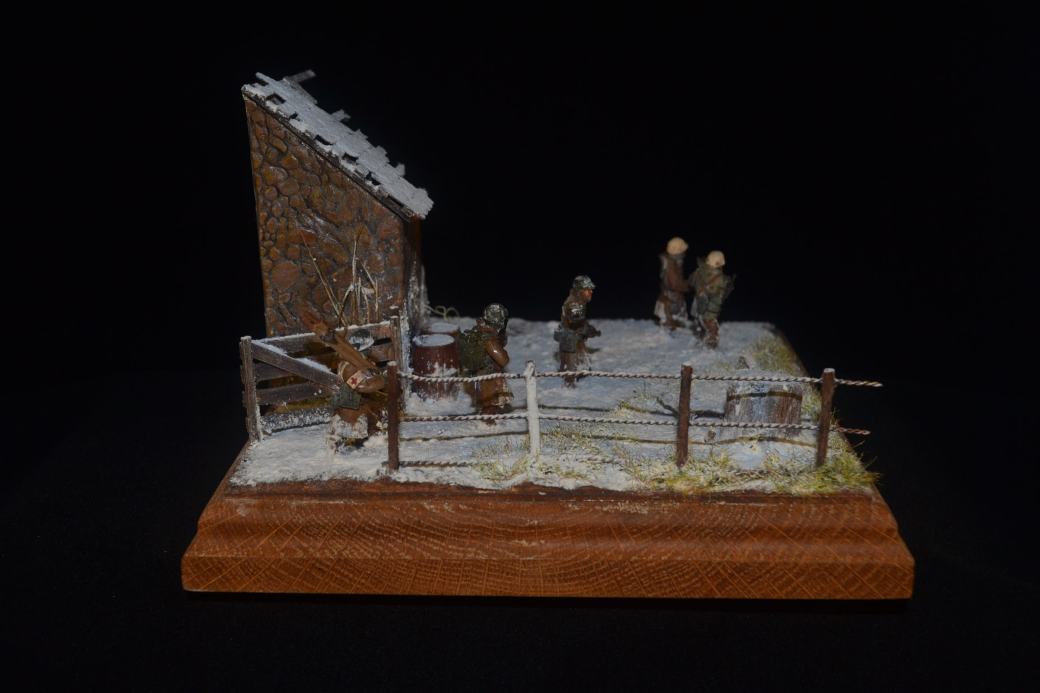
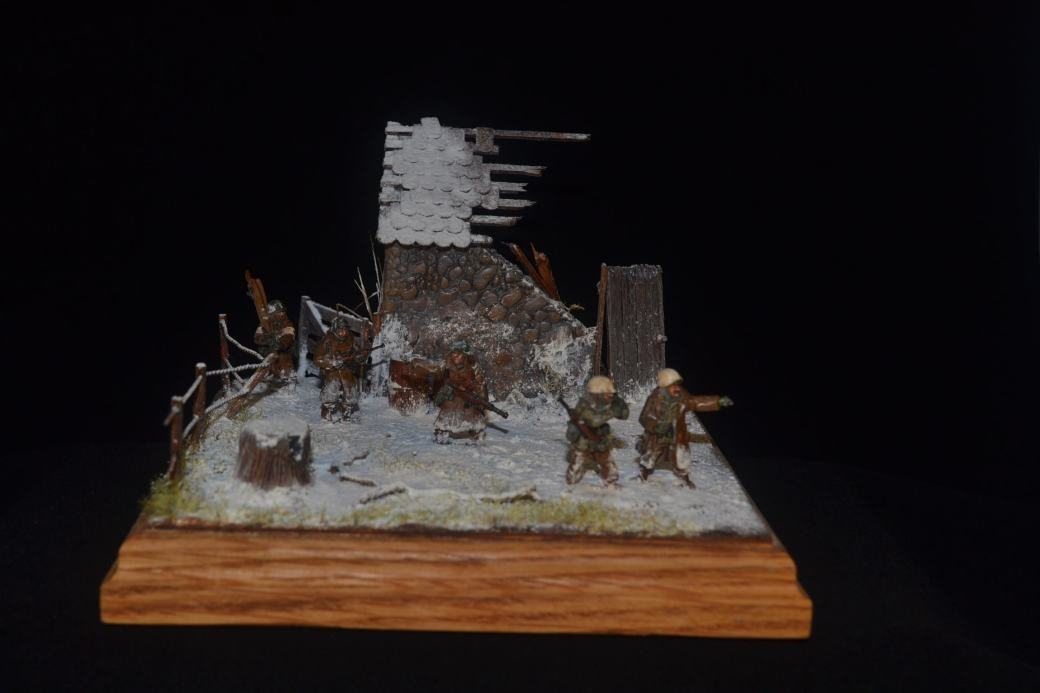
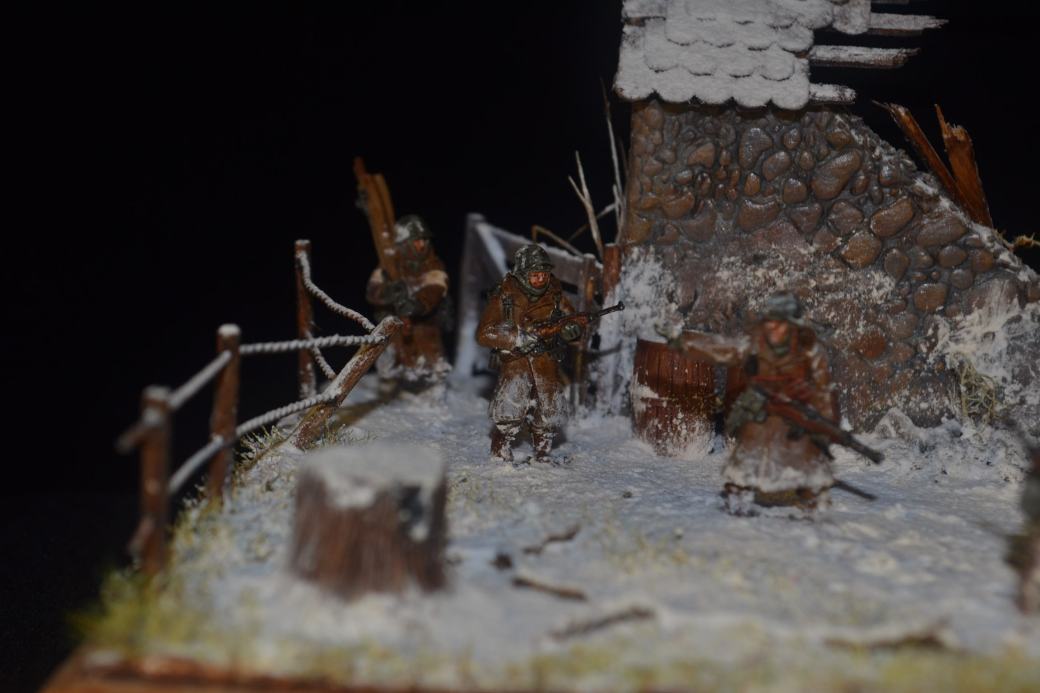
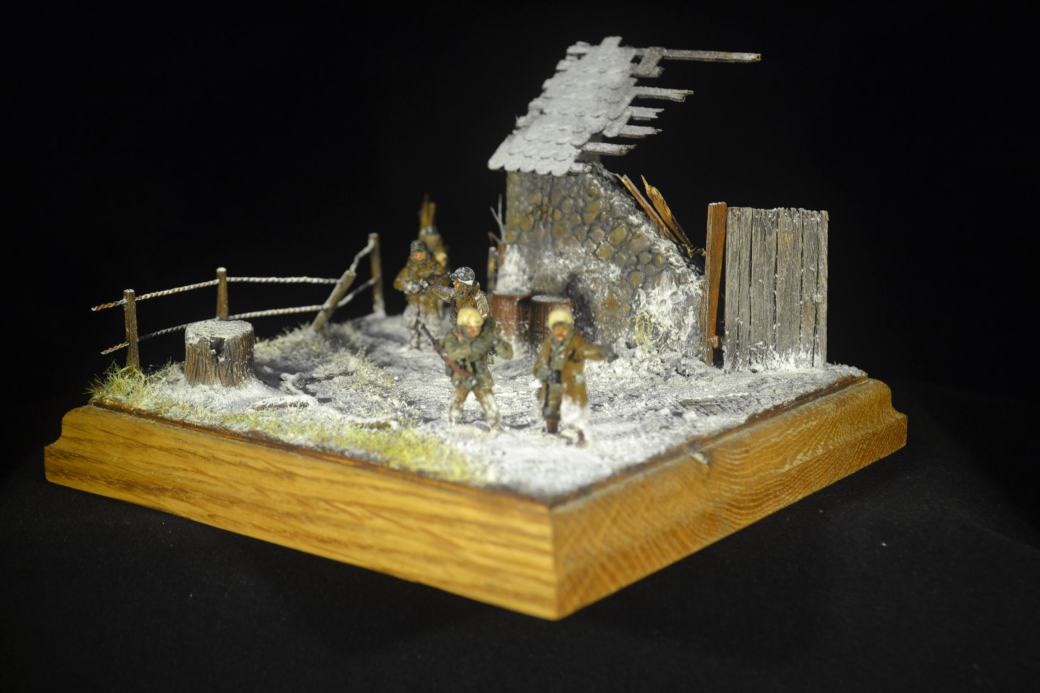
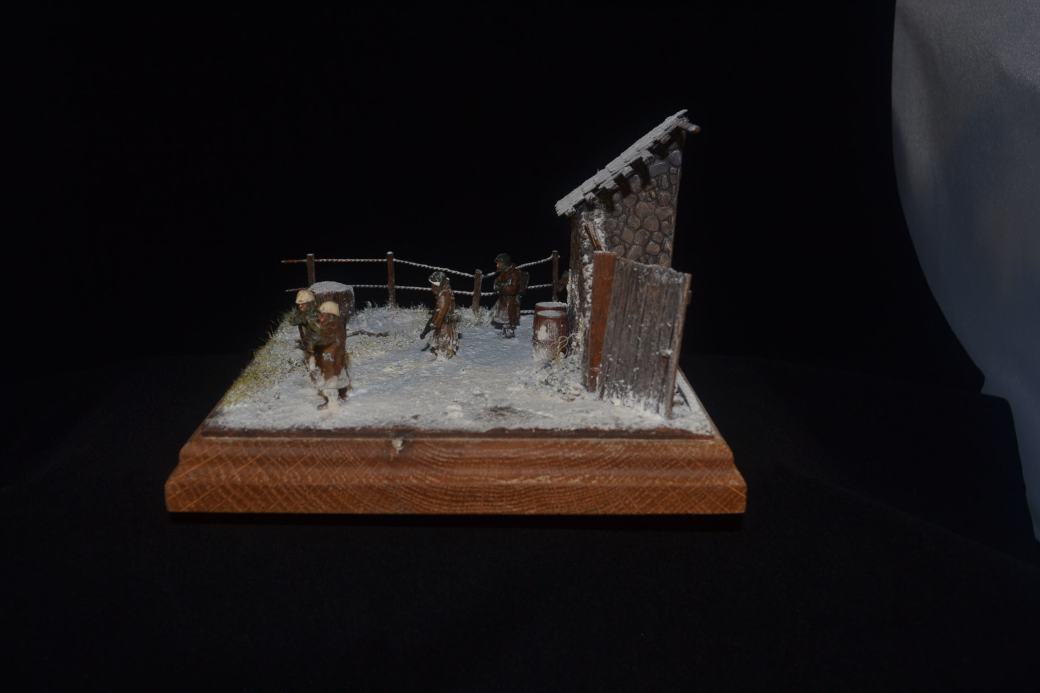
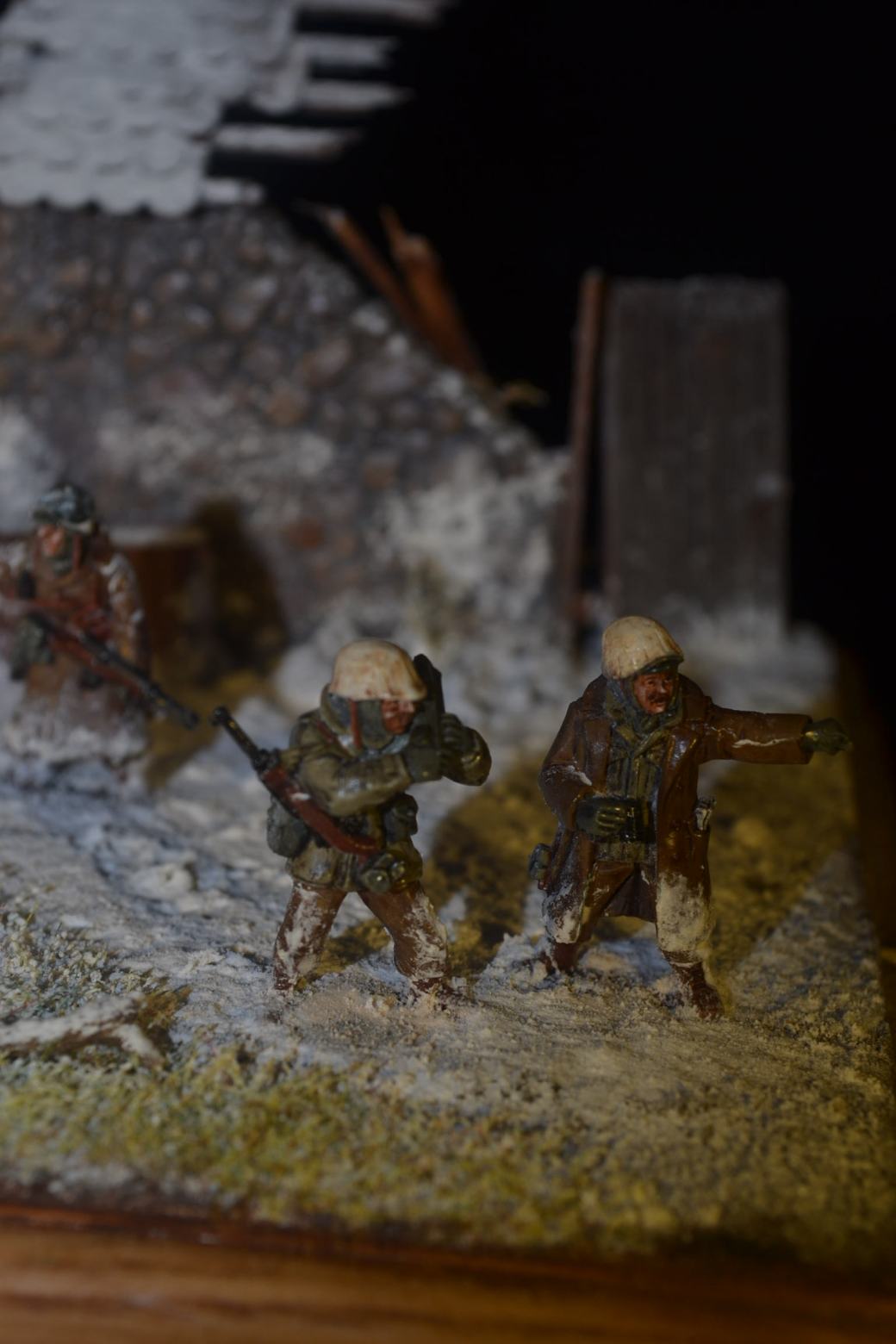
The concluding part of this little diorama.  With only the snow to be added I didn’t feel I could justify hanging onto this post until the weekend.

Figures fixed into position, all parts painted and assembled and ground work complete.  All that remained to be done was to apply the snow.

I mentioned in part 1 that I had acquired scenic snow materials from a company called Precision Ice and Snow.  A few words on what came in the bundle I bought, and before anyone asks no, I’m not on commission!

The various bits can all be bought separately or you can save quite a  bit by buying a bundle which is what I chose to do.  Everything arrived in a nice little draw string bag which contained:

  • 2 x 115g bags of Krycell fine (snow) for use with smaller scale models such as 28mm
  • 1 x 115g bag of Krycell Extra (snow) for use with larger models  – 1/35th upwards
  • 1 x 100ml bottle of adhesive
  • 1 x 50ml bottle of Ice and Snow wash
  • 1 x 50 tub of winter camouflage paint
  • 1 x sieve for applying the snow
  • 1 x instruction manual

All in all enough to do all the models in snow that I am likely to ever do.  The instruction book is great and there are various YouTube tutorials too if that’s of interest so I won’t bother going into greater detail.  Just to say that I followed the instructions and achieved the end result as shown in the pictures below.

Personally I like the stuff.  Looks realistic to me and goes where you put it.  For 28mm it’s really nice and fine and I love the way it has adhered to areas like the top of the fence and to the gate and barn door.  There are lots more ways of using this stuff and I’m looking forward to coming up with some other ideas in due course.

TIM


DSC_0793DSC_0792DSC_0789DSC_0797DSC_0790DSC_0796DSC_0793DSC_0794DSC_0791DSC_0798 (2)

28mm – WW2 US Winter Troops – Part 2

Desk tidied and lists written I am now feeling organised once again.  It’s now time to get some things completed and invoke a little more discipline starting with the continuation of this little diorama.

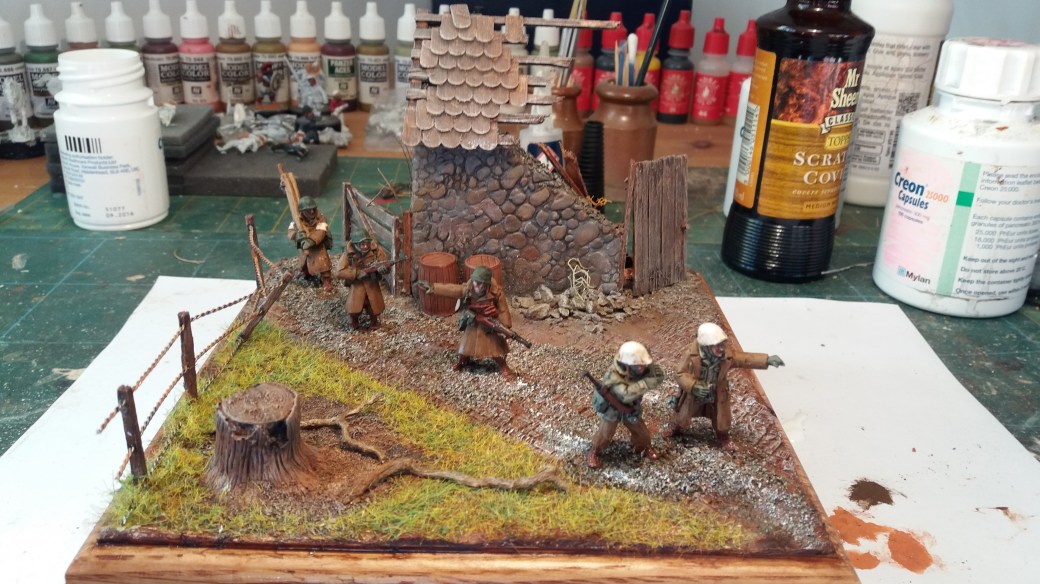
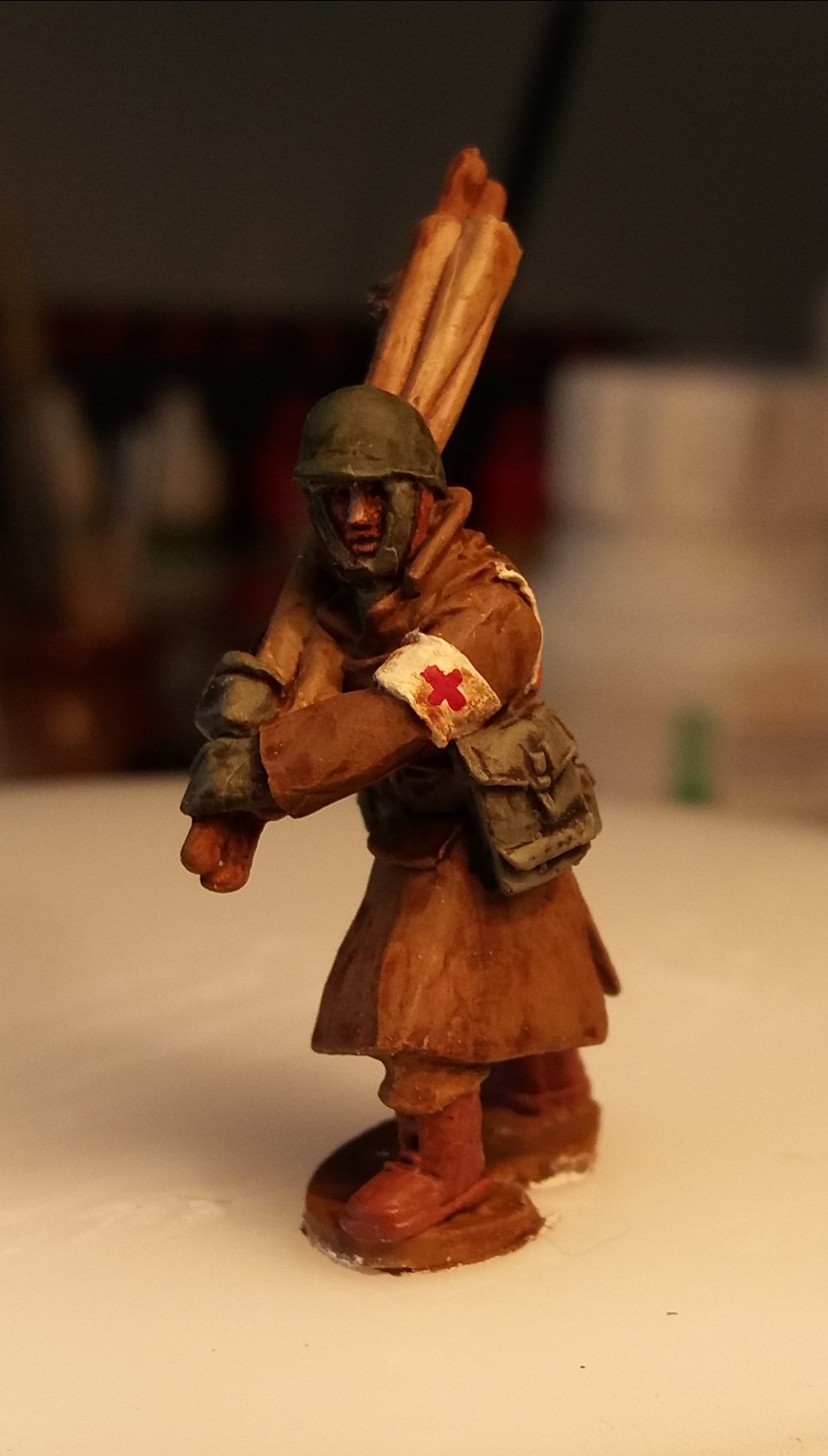
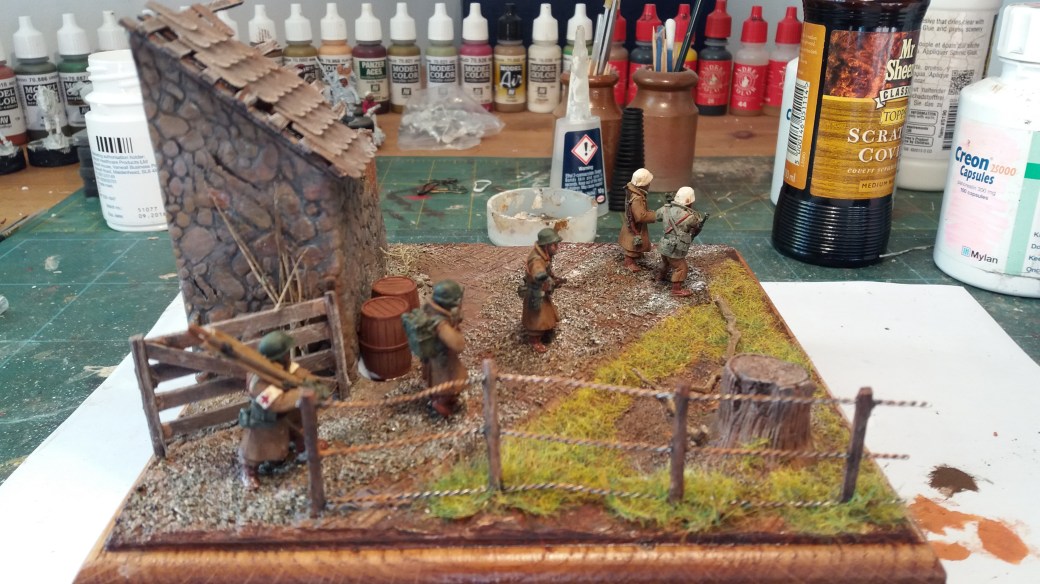
Figures have now been painted and “pre-snow” ground work almost completed. Figures arrived timely as always from Warlord Games and I was pleased with how they painted up.  The ground work to date was pretty straight forward but didn’t provide anything significantly new in modelling terms, that will come with adding the snow effect in what will be the third and final part of this little diorama.  All in all its gone together reasonably well so far.

The progress pictures below provide a good idea of how the completed diorama would look if I hadn’t decided to go for a snow scene.  It will be interesting to see just how it looks when a lot of it will get covered over.  Before and after photos should be interesting. Will it look better or worse?  No backing out now though.  I am committed to the end result so will have to wait and see. Besides I can’t have US troops wandering around in winter gear in the spring!

TIM

20180205_14365820180206_21342920180206_21332920180205_11351420180205_14371320180204_12234520180206_21340520180204_20460520180205_11351420180205_14373520180206_213238

28mm – WW2 US Winter Troops – Part 1

Tiring somewhat of WW1 I felt the need to undertake something new, not so much in terms of figures so much as terrain.

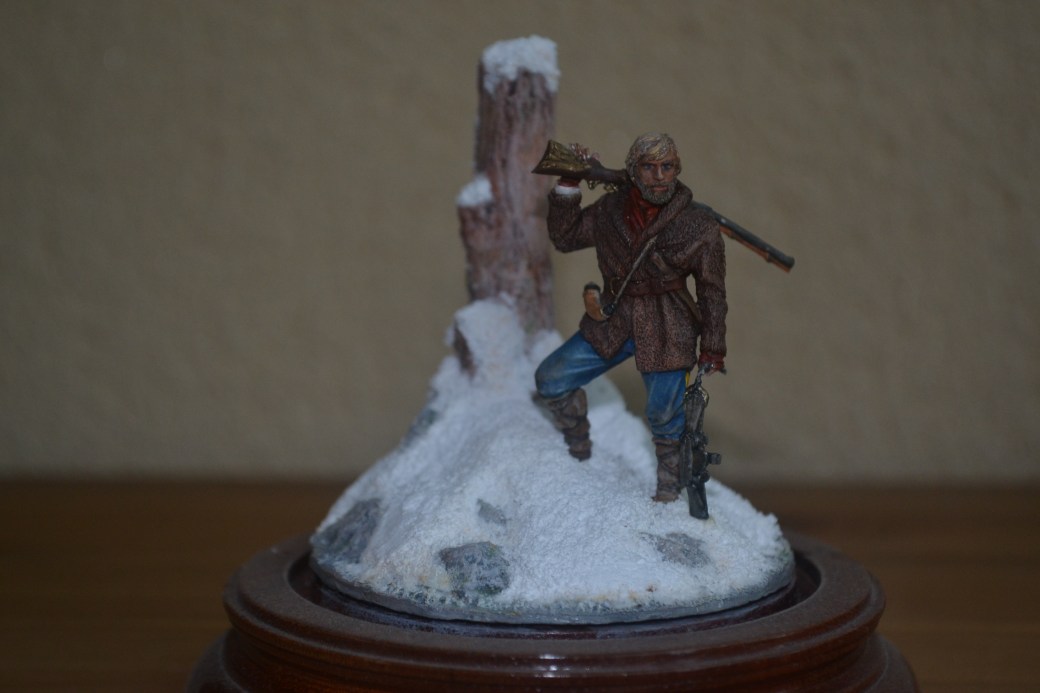
Until very recently I had only dabbled with snow affects once in the past and that was a long time ago.  The result of which ended in the model below.

DSC_0969

The model itself, an Andrea 54mm figure based on Robert Redford’s portrayal of Jeremiah Johnson if I remember correctly, came out OK at the time but the snow and my early attempt at a tree stump now look far from pleasing and very dated.  It was only when I was dusting it that I thought I wouldn’t mind having another go at some snow based models.

Now before I continue I ought to answer a question that I am sure the previous paragraph has thrown up.  Why was I, a product of the male chauvinistic 60’s, 70’s and 80’s, doing my own dusting when I have a perfectly good wife capable of doing such things?  A good question for sure but Her who Must Be Obeyed has made it perfectly clear that she will not be held responsible for any breakages and thus the job rests with me.  To be fair she has a point.  Allow me to digress a little further.

We have a border collie who can open every door in the house.  I was once the proud owner of a remote-controlled Dalek which spoke.  The dog hated the Dalek and ran from it when it was in use.  Her Who Must Be Obeyed in her infinite wisdom thought it would be a good idea to stand the Dalek in front of our bedroom door to stop the dog from going in.  A cunning plan but one which led to the dog trashing the Dalek and me calling her a moron.  It is against this back drop that she now has nothing to do with my models and collectibles! Hard to blame her really.

Back to modelling.

I had a good browse on the Warlord Games site and found some great looking 28mm US winter troops which I decided to purchase.  I then found some snow and ice products produced by Precision Ice and Snow which I also bought.  Not cheap but the amount of stuff that came in the bundle I purchased will more than see me through the rest of my modelling days I expect.  As for a scene I thought I’d go for a derelict building or part of one to be more precise.  The combination of US troops, snow and a derelict building all adds up to something completely brand new to get my teeth into.

A check on my paints resulted in the need to order some new ones, all Vallejo in this instance, and while I waited for them to arrive in the post I started to get my head around the build itself.  Initially I did think I could cut some corners given that most of the end result would be covered in snow but I then decided that was the wrong approach.  If I was to do it properly I ought to build the thing to look right before adding the snow, in that way what ever might show through would in turn look right too.

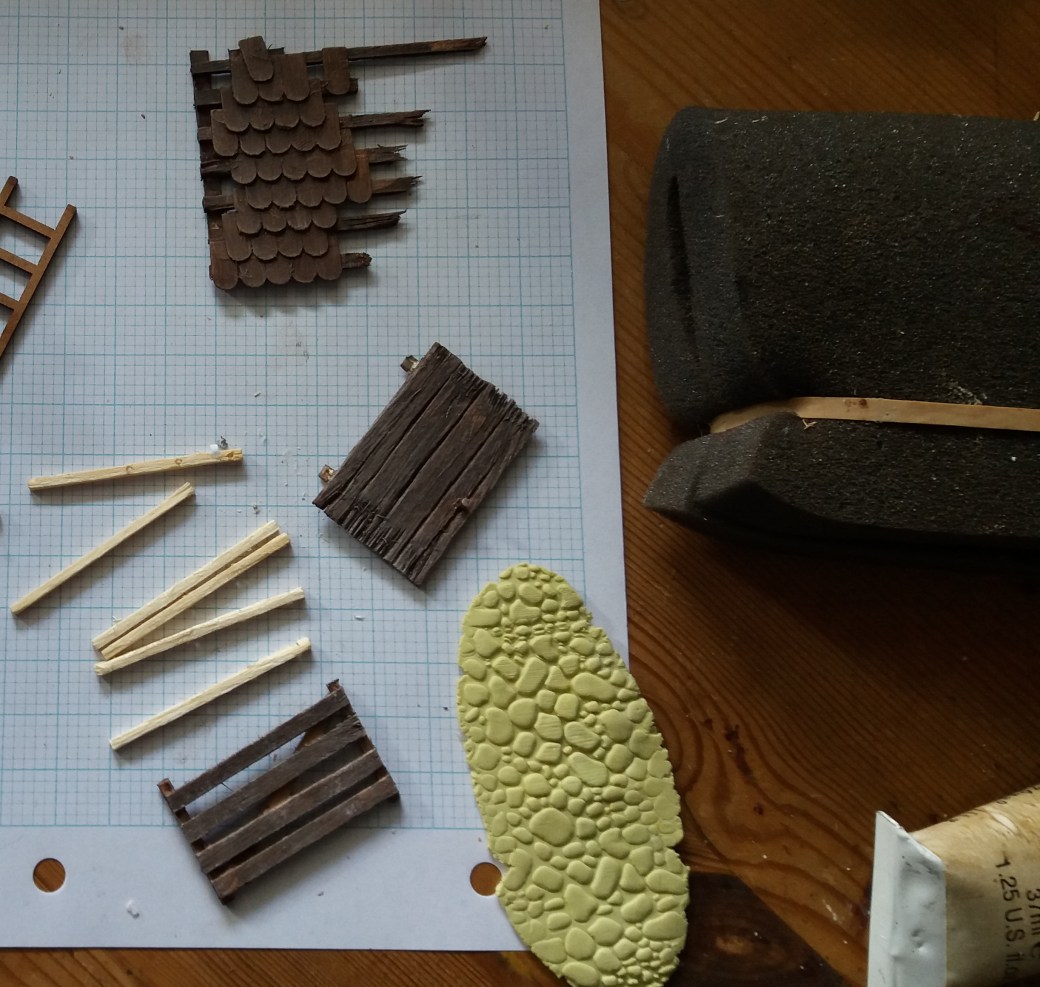
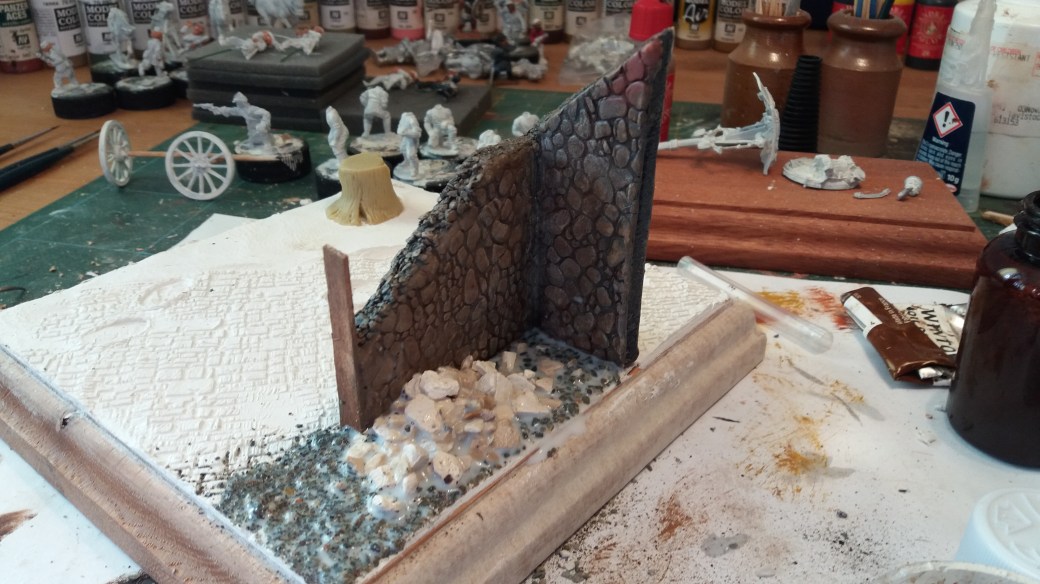
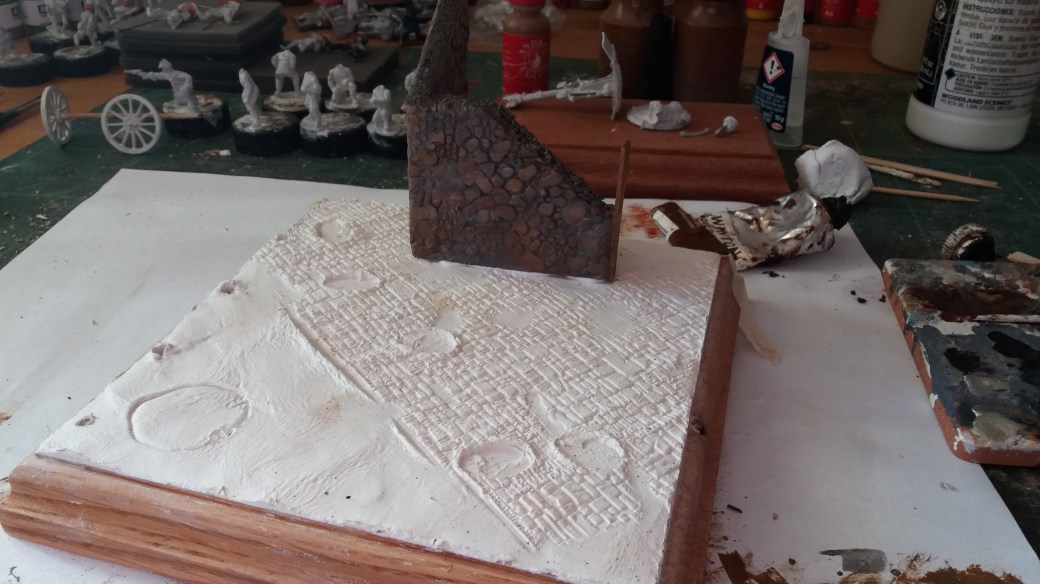
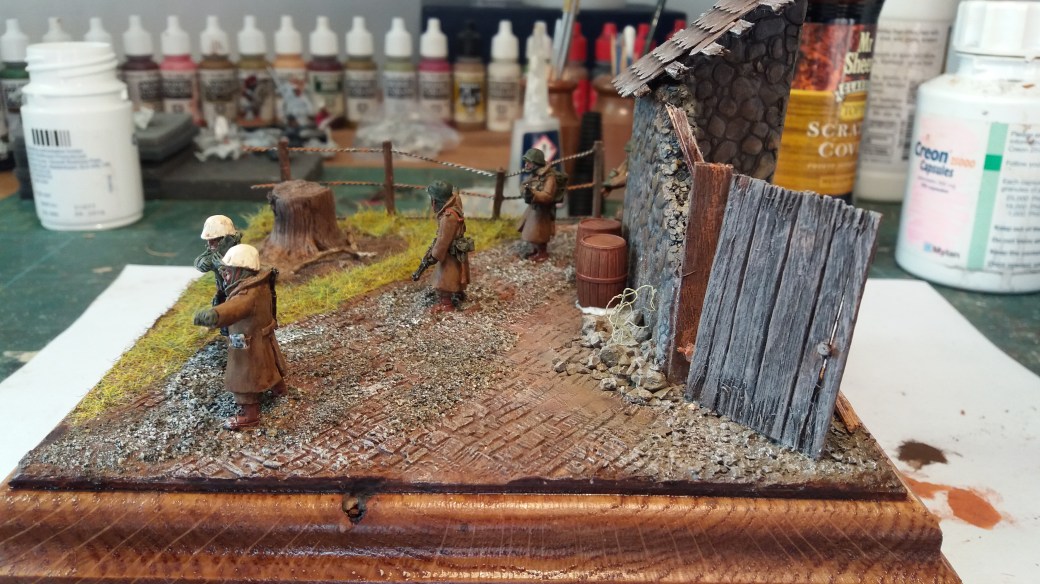
The mini project is now under way and the pictures below are of the early stages.  I initially cut out some foam board for the two wall sections which were then glued together.  Milliput was flattened out and then rolled using a Green Stuff World cobblestone textured rolling-pin and then applied to the foam board both on the inside and the outside.  A little tip I discovered.  In order to easily pick up the rolled Milliput first lay down some talcum powder on to your flat surface before hand, it lifts up easily that way.

The gate was made from wooden coffee stirrers as was the door and the roof beams.  The tiles were made once again using my Green Stuff World tile punch.  The fence posts were made from match sticks and drilled to make way for the twisted wire that will be inserted in due course.

Next up will be the complete assembly of all the various bits and pieces, the figure painting and applications of static grass and other ground work but that will have to wait until next time.  In the meanwhile a few very unexciting progress pictures.

TIM
20180206_20325420180130_20534820180204_14094120180204_12241220180204_135702